
Waterproofing is a critical requirement for many electronic products.
From wearable devices and outdoor sensors to automotive electronics and industrial control systems, electronic housings often need reliable protection against water, moisture, dust, and environmental contamination.
One of the most common sealing solutions is a custom silicone seal or gasket.
Silicone offers excellent flexibility, temperature resistance, weather resistance, compression recovery, and electrical insulation.
However, the performance of a waterproof silicone seal depends on much more than simply selecting a silicone material.
The gasket geometry, compression ratio, groove design, hardness, tolerance, surface finish, assembly force, and long-term compression set all influence sealing performance.
This guide explains the key design principles for silicone seals and gaskets used in waterproof electronic devices.
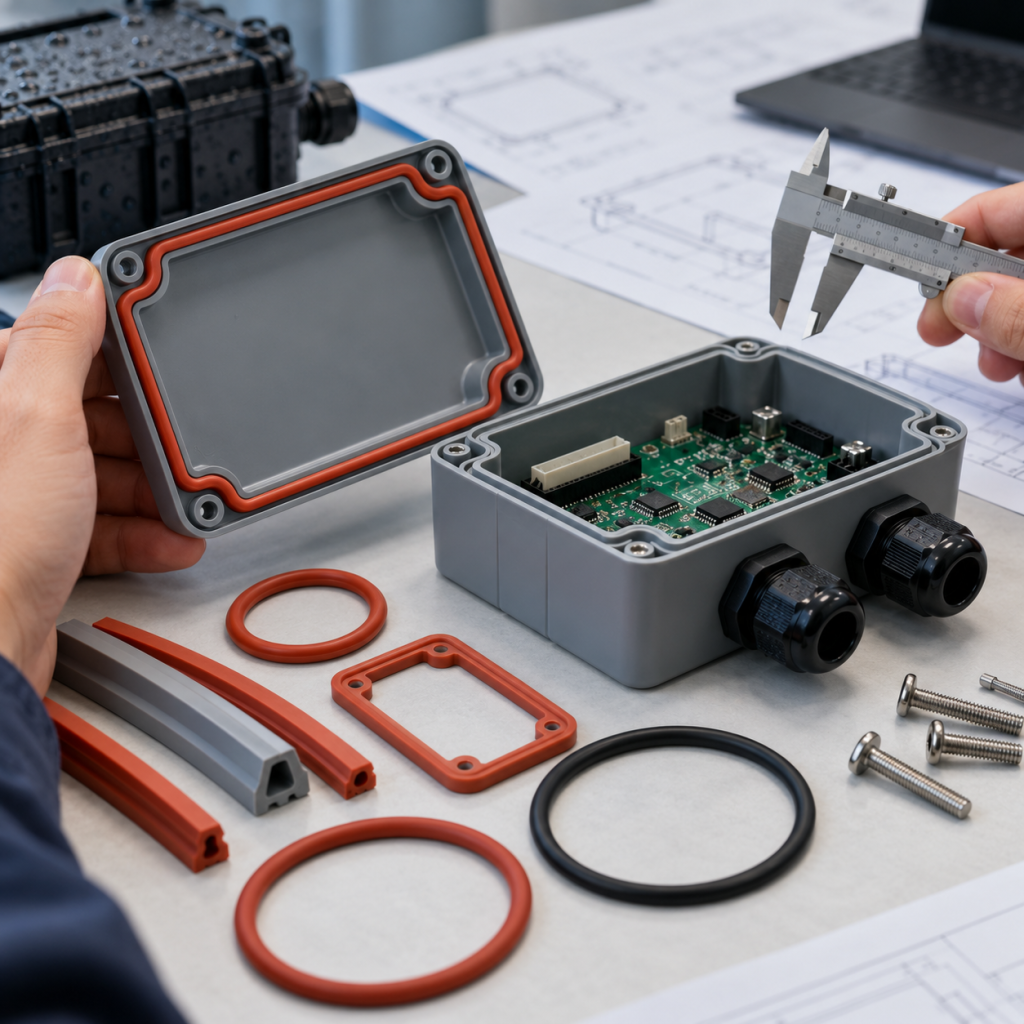
1. Why Silicone Is Widely Used for Electronic Sealing
Silicone rubber is widely used for waterproof sealing because it performs well under a broad range of environmental conditions.
Parmi les avantages habituels, on peut citer :
- Good flexibility
- Excellente résistance à la température
- UV resistance
- Ozone resistance
- Good weatherability
- Low compression set options
- Isolation électrique
- Résistance chimique
- Longue durée de vie
Silicone can also be molded into complex geometries, including:
- Joints plats
- Joints toriques
- Frame seals
- Joints à lèvre
- Joints d'étanchéité pour connecteurs
- Membranes
- Waterproof buttons
- Overmolded sealing structures
This makes silicone suitable for both simple housings and complex electronic assemblies.
2. Common Applications of Silicone Waterproof Seals
Custom silicone seals are widely used in:
- Électronique grand public
- Appareils domotiques
- Électronique portable
- Outdoor lighting
- Automotive electronics
- EV components
- Charging equipment
- Capteurs
- Industrial control systems
- Équipements de communication
- Boîtiers de batterie
- Electronic connectors
Different applications require different sealing structures.
For example, a wearable device may require a very small, soft gasket.
An industrial electronic enclosure may use a larger frame gasket with higher compression.
A waterproof connector may use multiple radial sealing ribs.
3. Understand the Required IP Rating
Before designing a silicone gasket, the waterproof target should be defined.
Many electronic products use an IP rating as a reference.
Parmi les exemples courants, on peut citer :
- IP54
- IP65
- IP66
- IP67
- IP68
Different IP levels represent different protection requirements.
For example, IP67 commonly involves temporary water immersion under defined test conditions.
IP68 normally represents more demanding immersion requirements agreed between the manufacturer and customer.
The required sealing structure should therefore be designed according to the actual product environment rather than simply aiming for the highest IP rating.
Parmi les facteurs importants, on peut citer :
- Pression de l'eau
- Profondeur d'immersion
- Durée d'immersion
- Température
- Repeated use
- Assembly frequency
4. Choose the Correct Silicone Hardness
Silicone hardness is normally measured in Shore A.
Common hardness values for sealing applications include:
- 30 Shore A
- 40 Shore A
- 50 Shore A
- 60 Shore A
- 70 Shore A
Softer silicone deforms more easily and can seal uneven surfaces.
However, very soft silicone may move, distort, or extrude under compression.
Harder silicone provides better dimensional stability but requires more assembly force.
For many electronic gasket applications, 40 to 60 Shore A is a common starting range.
The final hardness should be selected according to:
- Compression force
- Housing stiffness
- Gasket size
- Géométrie des rainures
- Méthode d'assemblage
- Planéité de la surface
- Température de fonctionnement
5. Compression Ratio Is One of the Most Important Factors
A silicone gasket creates a seal by being compressed between two mating surfaces.
If compression is too low, the gasket may not create sufficient sealing force.
If compression is too high, the gasket may experience excessive stress and permanent deformation.
The correct compression ratio depends on the gasket geometry and material.
For many static silicone seals, moderate compression is generally preferred.
The design should provide enough deformation to create continuous contact without overstressing the material.
Too little compression can cause:
- Fuite d'eau
- Pénétration de la poussière
- Uneven sealing
- Lacunes locales
Too much compression can cause:
- Déformation permanente
- Gasket extrusion
- Difficulté de montage
- Excessive housing stress
- Durée de vie réduite
Compression should therefore be evaluated during DFM and validation testing.
6. Design the Groove Correctly
The gasket groove controls the position and compression of the silicone seal.
A well-designed groove helps prevent the gasket from moving during assembly.
Important groove parameters include:
- Largeur de la rainure
- Profondeur de rainure
- Rayon de courbure
- Gasket volume
- Compression ratio
- Gland fill
The groove should provide enough space for the silicone to deform.
If the groove is too small, the gasket may have nowhere to expand.
This can create excessive stress.
If the groove is too large, the gasket may move or fail to achieve sufficient compression.
7. Avoid Sharp Corners
Sharp corners can create stress concentration in silicone seals.
Rounded corners are generally better for both sealing performance and moldability.
Sharp internal corners may also make tooling more difficult.
For frame gaskets, smooth radius transitions can help:
- Improve material flow
- Reduce tearing risk
- Improve compression consistency
- Simplify mold manufacturing
When possible, use generous corner radii.
8. Use a Continuous Sealing Path
A waterproof gasket should provide a continuous sealing path around the protected area.
Interruptions can create leakage points.
The sealing path should avoid unnecessary:
- Breaks
- Joints
- Changements brusques d'épaisseur
- Sharp geometry transitions
For high-reliability applications, a one-piece molded silicone gasket is often preferred over multiple joined sealing components.
9. Control Gasket Cross-Section
The cross-section of the gasket has a major influence on sealing performance.
Common gasket cross-sections include:
- Rectangular
- Circular
- D-shaped
- Lip-shaped
- Multi-rib
- Hollow
A rectangular frame gasket is simple and widely used.
A rounded or D-shaped gasket can provide more controlled compression.
Multi-rib designs may improve sealing by creating multiple contact lines.
The best cross-section depends on:
- Housing design
- Available space
- Compression force
- Waterproof target
- Méthode d'assemblage
10. Consider Double-Lip or Multi-Rib Sealing
For demanding waterproof applications, multiple sealing ribs can be used.
A multi-rib design provides more than one sealing barrier.
If a small amount of water passes the first sealing line, the second rib may provide additional protection.
This type of structure is common in:
- Connecteurs étanches
- Automotive electronics
- Outdoor devices
- Industrial electronics
However, more ribs also increase design complexity and assembly force.
11. Compression Set Is Critical
Compression set measures how much permanent deformation remains after silicone has been compressed for a period of time.
A low-compression-set silicone is highly desirable for long-term sealing.
If the gasket permanently loses its original height, the sealing force may decrease.
This can lead to leakage after months or years of use.
Compression set is affected by:
- Formulation des matériaux
- Température
- Compression level
- Heure
- Conditions de post-durcissement
For long-term electronic sealing applications, the silicone material should be selected with compression set performance in mind.
12. Temperature Changes Affect Seal Performance
Electronic devices may experience large temperature variations.
En voici quelques exemples :
- Outdoor electronics
- Automotive modules
- EV charging equipment
- Industrial controls
Temperature changes can affect both the silicone gasket and the housing.
Different materials expand and contract at different rates.
For example, plastic housings and aluminum housings may behave differently.
The gasket must maintain sealing pressure across the full operating temperature range.
13. Housing Flatness Matters
Even a well-designed gasket cannot compensate for unlimited housing deformation.
If the mating surfaces are not flat, some areas may receive more compression than others.
This can create leakage paths.
Important mechanical factors include:
- Housing flatness
- Screw position
- Couple de serrage des vis
- Épaisseur de la paroi
- Structural stiffness
For large covers, additional screws or reinforcement ribs may be required.
14. Screw Placement Affects Compression
Fasteners help create uniform gasket compression.
If screws are spaced too far apart, the housing may bend between fastening points.
This reduces sealing pressure in some areas.
The screw layout should provide consistent compression around the gasket.
This is particularly important for:
- Large rectangular housings
- Feuilles de plastique fines
- Industrial enclosures
- Couvercles de batterie
15. Avoid Excessive Gasket Stretch During Assembly
A silicone gasket should not be stretched too much during installation.
Stretching changes the cross-section and can reduce sealing performance.
For frame gaskets, the gasket should fit naturally into the groove.
If the gasket must be stretched during assembly, dimensional control should be carefully reviewed.
16. Silicone Shrinkage Must Be Considered
Silicone materials shrink during molding and curing.
The mold must compensate for this shrinkage.
The amount of shrinkage depends on:
- Silicone formulation
- Procédé de moulage
- Température du moule
- Conditions de guérison
- Product geometry
For precision electronic seals, the manufacturer should evaluate shrinkage during mold design.
17. LSR vs HCR for Waterproof Seals
Both LSR and HCR can be used for electronic sealing components.
LSR
Liquid Silicone Rubber is suitable for:
- Production à grande échelle
- Small precision seals
- Lèvres d'étanchéité fines
- Joints d'étanchéité pour connecteurs
- Complex geometry
- Moulage automatisé
LSR provides excellent repeatability and is suitable for precision electronic applications.
HCR
High Consistency Rubber is suitable for:
- Larger gaskets
- Frame seals
- Joints industriels
- Lower-volume projects
- Simpler geometries
HCR compression molding may provide lower tooling cost for larger or simpler gasket designs.
18. Overmolded Silicone Seals
Instead of assembling a separate gasket, silicone can sometimes be overmolded directly onto a plastic or metal component.
This is known as silicone overmolding.
Advantages may include:
- Fewer assembly steps
- Reduced gasket movement
- Better component integration
- Improved sealing consistency
- Reduced risk of missing gaskets
Silicone overmolding can be used with compatible materials such as:
- PC
- PA
- PBT
- PPSU
- Acier inoxydable
- Aluminium
The substrate material and bonding method should be evaluated carefully.
19. Waterproof Connector Seals
Electronic connectors require special sealing structures.
Typical connector seals include:
- Wire seals
- Radial seals
- Face seals
- Multi-hole seals
- Cable entry seals
These components may require precise control of:
- Diamètre du trou
- Sealing rib geometry
- Dureté
- Insertion force
- Compression
- Finition de surface
For automotive and industrial connectors, the seal must also maintain performance after repeated vibration and temperature cycling.
20. Avoid Excessive Flash on Sealing Surfaces
Flash on a critical sealing surface can create leakage paths.
For precision gaskets, the parting line should be carefully positioned.
Critical sealing surfaces should ideally avoid heavy flash.
Tooling quality and process control are essential.
The drawing should clearly identify:
- Critical sealing surfaces
- Flash limits
- Parting line restrictions
21. Surface Finish Affects Sealing
Surface roughness on both the silicone gasket and housing can influence sealing.
A very rough surface can create microscopic leakage paths.
For precision waterproof devices, the sealing surface should be reasonably smooth and consistent.
Surface texture may still be used in non-critical areas.
22. Tolerance Design
Tolerances must be considered for both the gasket and the housing.
Important dimensions include:
- Gasket thickness
- Profondeur de rainure
- Largeur de la rainure
- Housing gap
- Compression height
Tolerance stack-up can change the actual compression ratio.
Par exemple :
If the gasket is at the minimum thickness and the groove is at the maximum depth, compression may be too low.
If the gasket is at maximum thickness and the groove is at minimum depth, compression may be too high.
Tolerance analysis should therefore be completed during the design stage.
23. Test the Complete Assembly
Waterproof performance cannot be confirmed by inspecting the gasket alone.
The complete assembled product should be tested.
Common validation methods include:
- Air leak testing
- Pressure decay testing
- Vacuum testing
- Water spray testing
- Immersion testing
- IP testing
For high-reliability products, testing may also include:
- Cycles thermiques
- Humidity testing
- Essais de vibration
- Essais de vieillissement
These tests help identify sealing problems before mass production.
24. Common Causes of Waterproof Seal Failure
Waterproof electronic products can fail for many reasons.
Parmi les causes courantes, on peut citer :
Compression insuffisante
The gasket does not generate enough sealing force.
Compression excessive
The gasket becomes permanently deformed.
Poor Housing Flatness
Compression is uneven.
Incorrect Groove Design
The silicone cannot deform correctly.
Flash on Sealing Surfaces
Small leakage paths may form.
Material Compression Set
Long-term sealing force decreases.
Assembly Error
The gasket may twist, move, or become trapped.
Incorrect Screw Torque
Uneven fastening can create local leakage.
25. How to Improve Waterproof Gasket Reliability
To improve sealing reliability:
- Define the required IP level
- Choose suitable silicone hardness
- Use controlled gasket compression
- Design the groove correctly
- Avoid sharp corners
- Use low-compression-set silicone
- Control gasket tolerances
- Maintain housing flatness
- Optimize screw locations
- Test the complete assembly
A DFM review before tooling can identify many potential sealing problems.
26. What Information Should You Send for a Silicone Gasket Quote?
For an accurate quotation, provide:
- Dessin en 2D
- Fichier CAO 3D
- Gasket dimensions
- Dureté du silicone
- Besoins en matériel
- Température de fonctionnement
- Required IP rating
- Volume annuel
- Quantité de la commande initiale
- Matériau du boîtier
- Application information
If waterproof testing is required, include the test conditions.
Conclusion
Designing a waterproof silicone seal requires careful control of both material and mechanical structure.
The most important factors include:
- Dureté du silicone
- Compression ratio
- Groove design
- Déformation rémanente après compression
- Housing flatness
- Tolerance stack-up
- Assembly force
- Conditions environnementales
A well-designed gasket can provide reliable waterproof protection for electronic products over a long service life.
Fuhongying provides custom silicone seals, silicone gaskets, LSR sealing components, waterproof connector seals, and silicone overmolding services for OEM and ODM projects.
We support applications in consumer electronics, automotive electronics, industrial equipment, medical devices, and other waterproof electronic products.
Send us your drawing, 3D file, application requirements, and target IP rating for a DFM review and quotation.
FAQ
What silicone hardness is best for waterproof gaskets?
There is no single best hardness. For many electronic sealing applications, 40 to 60 Shore A is a common starting range. The final hardness depends on gasket geometry, assembly force, compression, and housing design.
Dans quelle mesure un joint en silicone doit-il être comprimé ?
The required compression depends on the gasket shape, material hardness, groove design, and application. Too little compression can cause leakage, while excessive compression can reduce gasket life.
Is silicone suitable for IP67 and IP68 sealing?
Yes. Silicone is widely used in IP67 and IP68 products. However, waterproof performance depends on the complete assembly design, not only on the gasket material.
Which is better for waterproof seals, LSR or HCR?
LSR is often preferred for precision, high-volume, small, or complex sealing components. HCR is commonly used for larger frame gaskets and lower-volume projects.
What causes silicone gaskets to leak?
Common causes include insufficient compression, poor housing flatness, incorrect groove design, excessive flash, compression set, assembly errors, and tolerance stack-up.
Can silicone be overmolded onto plastic for waterproofing?
Yes. Silicone can be overmolded onto compatible plastics or metals to create integrated sealing structures. Material compatibility and bonding design should be reviewed before tooling.
 English
  Japanese
  Korean
  German
  French
  Italian
  Spanish
  Dutch
Dutch  Chinese
  Portuguese
  Polish
  Czech
Czech  Hungarian
  Swedish
  Finnish
  Vietnamese
  Thai
Thai  Turkish
  Arabic
  Russian