
1. Johdanto
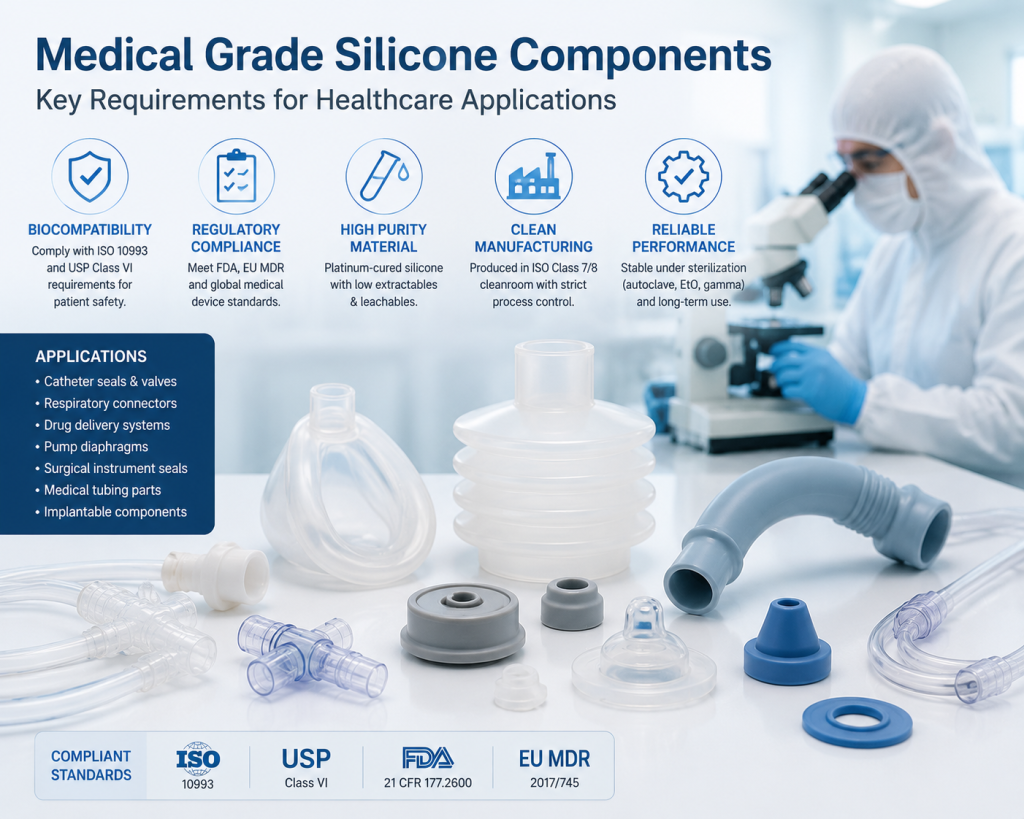
Medical grade silicone components are widely used in modern healthcare systems due to their excellent biocompatibility, chemical stability, and long-term reliability. Applications include surgical instruments, drug delivery systems, catheters, sealing components, respiratory devices, and implantable-grade auxiliary parts.
Unlike industrial silicone, medical-grade silicone must meet strict regulatory, material, and manufacturing standards to ensure patient safety and device reliability.
2. What Is Medical Grade Silicone?
Medical grade silicone is typically based on:
- Platinum-cured Liquid Silicone Rubber (LSR)
- High-purity elastomer systems
- Low-extractable and low-volatile formulations
Key characteristics:
- Biocompatibility
- Non-toxic and non-reactive
- Stable under sterilization processes
- Resistance to bodily fluids and chemicals
- Long-term mechanical stability
It is widely used in both short-term patient contact devices and long-term medical components.
3. Key Regulatory Standards
Medical silicone components must comply with international healthcare regulations:
3.1 ISO 10993 (Biocompatibility)
Defines biological evaluation of medical devices, including:
- Cytotoxicity
- Sensitization
- Irritation
- Long-term implantation safety
3.2 USP Class VI
One of the highest standards for medical polymers:
- Acute systemic toxicity test
- Intracutaneous reactivity
- Implantation evaluation
3.3 FDA Medical Device Compliance
Silicone materials used in healthcare applications must comply with:
- FDA 21 CFR 177.2600 (food & medical contact elastomers)
3.4 EU MDR (Medical Device Regulation)
Ensures:
- Materiaalien jäljitettävyys
- Risk management
- Clinical safety validation
4. Critical Material Requirements
4.1 Ultra-High Purity Silicone
Medical applications require:
- Very low residual catalysts
- Minimal volatile organic compounds (VOCs)
- Controlled molecular weight distribution
4.2 Platinum Curing System
Compared to peroxide curing:
- No peroxide residues
- Better biocompatibility
- Higher optical and chemical purity
4.3 Extractables & Leachables Control
Medical devices must ensure:
- No harmful migration into human tissue or fluids
- Stable performance under sterilization conditions
5. Manufacturing Requirements
5.1 Clean Production Environment
Medical silicone components often require:
- Cleanroom manufacturing (ISO Class 7–8 or higher)
- Dust-free molding environment
- Controlled humidity and temperature
5.2 LSR-ruiskupuristus
Liquid Silicone Rubber (LSR) is preferred due to:
- High precision molding
- Repeatability for mass production
- Lyhyt kovettumisaika
- Excellent sealing performance
5.3 Jälkikovetusprosessi
Post-curing ensures:
- Removal of volatile compounds
- Improved odor neutrality
- Enhanced long-term stability
5.4 Traceability System
Each batch must be traceable:
- Raw material batch number
- Production parameters
- QC records
- Sterilization compatibility data
6. Typical Medical Applications
Medical grade silicone components are used in:
- Catheter seals and valves
- Respiratory masks and connectors
- Drug delivery systems
- Pump diaphragms
- Surgical instrument seals
- Medical tubing connectors
- Implantable auxiliary parts
7. Common Engineering Challenges
7.1 Dimensional Stability
Medical parts require extremely tight tolerances (±0.02–0.05 mm in some cases).
7.2 Sterilization Resistance
Components must withstand:
- Autoclave (steam sterilization)
- Gammasäteily
- Ethylene oxide (EtO)
7.3 Material Aging
Long-term exposure to:
- Temperature cycles
- Chemical disinfectants
- Mechanical stress
must not degrade performance.
8. Future Trends in Medical Silicone
The medical silicone industry is moving toward:
- LSR micro-precision molding
- Multi-material overmolding (silicone + plastic + metal)
- Smart medical device integration
- Higher regulatory transparency
- Minimally invasive device components
9. Johtopäätös
Medical grade silicone components play a critical role in modern healthcare systems. Successful development requires not only advanced materials, but also strict compliance with ISO, USP, FDA, and EU MDR standards, as well as precise manufacturing control.
Manufacturers with strong LSR engineering capabilities and clean production systems will have a significant advantage in the global medical device supply chain.
 English
  Japanese
  Korean
  German
  French
  Italian
  Spanish
  Dutch
Dutch  Chinese
  Portuguese
  Polish
  Czech
Czech  Hungarian
  Swedish
  Finnish
  Vietnamese
  Thai
Thai  Turkish
  Arabic
  Russian