
Liquid Silicone Rubber (LSR) has become one of the most important advanced elastomer materials in modern manufacturing, especially in industries requiring high reliability, precision, safety, and durability. From medical devices and baby care products to automotive components, wearable electronics, and industrial sealing systems, LSR provides unique performance advantages that traditional silicone materials cannot always achieve.
For product designers and engineers, understanding LSR is essential when selecting materials for complex components. The choice of silicone material affects not only product performance but also manufacturing efficiency, regulatory compliance, service life, and overall product cost.
This article provides a comprehensive overview of Liquid Silicone Rubber, including its chemical characteristics, manufacturing process, advantages, applications, and key design considerations.
1. What Is Liquid Silicone Rubber (LSR)?
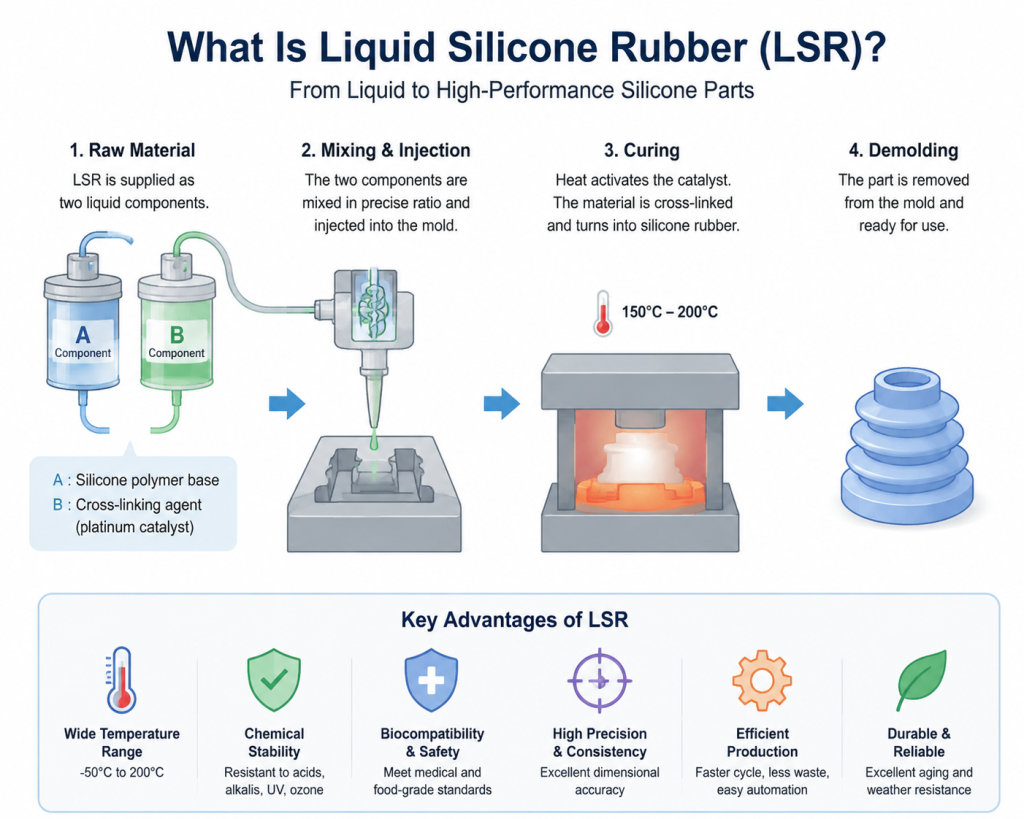
Liquid Silicone Rubber (LSR) is a two-component, platinum-cured silicone elastomer that is processed in a liquid state and transformed into a flexible rubber material through injection molding.
Unlike traditional high consistency rubber (HCR), which is supplied as solid silicone gum and requires mechanical mixing before molding, LSR is delivered as two liquid components:
- Component A: Silicone polymer base
- Component B: Cross-linking agent containing curing catalyst
During the molding process, these two components are precisely mixed and injected into a heated mold. Under controlled temperature conditions, the material undergoes a chemical cross-linking reaction and becomes an elastic silicone part.
The basic curing reaction can be summarized as:
Liquid silicone mixture → Cross-linked silicone network → Flexible silicone elastomer
This advanced processing method enables manufacturers to produce highly precise silicone components with excellent consistency and repeatability.
2. Chemical Structure and Material Characteristics of LSR
Liquid Silicone Rubber belongs to the family of silicone elastomers based on polysiloxane polymers.
The backbone structure mainly consists of:
Silicon (Si) – Oxygen (O) – Silicon (Si) bonds
This molecular structure provides LSR with several unique properties:
2.1 Excellent Temperature Resistance
One of the most significant advantages of LSR is its wide operating temperature range.
Typical performance:
- Continuous working temperature:
- Přibližně od -50 °C do +200 °C
- Special formulations:
- Can withstand temperatures above 250°C
This makes LSR suitable for applications exposed to heat, sterilization processes, or extreme environments.
Příklady:
- Medical sterilization equipment
- Automotive engine components
- Semiconductor equipment seals
2.2 Excellent Chemical Stability
LSR has outstanding resistance against many chemicals, including:
- Water
- Humidity
- UV záření
- Ozone
- Many acids and alkalis
This stability allows silicone components to maintain their physical properties even after long-term exposure to harsh environments.
2.3 Biocompatibility and Safety
Medical-grade LSR can meet strict requirements such as:
- ISO 10993 biological evaluation
- USP Class VI testing
- Food-contact safety requirements
Because of its purity, softness, and chemical stability, LSR is widely used in:
- Savičky na kojenecké lahve
- Lékařské hadičky
- Chirurgické komponenty
- Nositelná zdravotnická zařízení
3. LSR Manufacturing Process
The manufacturing process of Liquid Silicone Rubber is highly automated and requires precise control.
Krok 1: Příprava materiálu
LSR is supplied as two separate liquid components.
The material is stored in:
- Component A container
- Component B container
A specialized metering system controls the mixing ratio, usually:
A : B = 1 : 1
Step 2: Mixing and Injection
The two components are pumped into a mixing unit where they are blended uniformly.
The mixed silicone material is then injected into a heated mold.
Compared with traditional silicone molding, LSR injection molding provides:
- Faster production speed
- Better dimensional accuracy
- Lower material waste
Step 3: Curing Process
Inside the mold, heat activates the platinum catalyst.
The silicone molecules form cross-linked structures, converting the liquid material into a solid elastic component.
Typical curing temperature:
- 150°C–200°C
Curing time depends on:
- Part thickness
- Teplota formy
- Material formulation
Step 4: Demolding and Inspection
After curing:
- Parts are removed from the mold
- Flash is trimmed
- Surface quality is inspected
- Dimensions are verified
For high-precision applications, manufacturers may conduct:
- Optical inspection
- Zkoušky tvrdosti
- Tensile testing
- Zkouška trvalé deformace
4. LSR Injection Molding vs Traditional Silicone Processing
| Funkce | Vstřikování LSR | Traditional HCR Silicone |
|---|---|---|
| Material State | Liquid | Solid gum |
| Processing Method | Automated injection | Lisování pod tlakem |
| Production Speed | Vysoká | Medium |
| Precision | Excellent | Good |
| Material Waste | Low | Higher |
| Complex Geometry | Excellent | Limited |
| Automation Level | Vysoká | Medium |
| Cleanliness | Excellent | Good |
For mass production requiring consistency and precision, LSR injection molding provides significant advantages.
5. Advantages of Liquid Silicone Rubber
5.1 High Precision Manufacturing
LSR can fill very small and complex mold cavities, making it suitable for:
- Micro seals
- Thin-wall components
- Zdravotnické konektory
- Electronic protection parts
Advanced molding technology allows manufacturers to achieve tight dimensional tolerances.
5.2 Soft Touch and Flexible Performance
LSR provides:
- Soft surface feel
- High elasticity
- Excellent compression recovery
These properties make it ideal for consumer products where comfort is important.
Příklady:
- Wearable device straps
- Výrobky pro děti
- Silicone grips
5.3 Long-Term Aging Resistance
Compared with many organic elastomers, LSR maintains performance over long periods.
It resists:
- Aging
- Cracking
- Žloutnutí
- Hardening
This improves product reliability and reduces maintenance requirements.
5.4 Clean and Automated Production
LSR molding systems can operate with:
- Automatic material feeding
- Closed production environments
- Minimal manual handling
This makes LSR suitable for industries with strict cleanliness requirements.
6. Main Applications of LSR
6.1 Medical Industry
Medical applications represent one of the fastest-growing markets for LSR.
Typical products include:
- Zdravotnické konektory
- Silikonové ventily
- Respiratory components
- Součásti katétru
- Drug delivery parts
Výhody:
- Biokompatibilita
- Odolnost vůči sterilizaci
- Chemická stabilita
6.2 Baby Care Products
LSR is widely used in infant products because of its safety and softness.
Použití:
- Savičky na kojenecké lahve
- Teething toys
- Příslušenství pro krmení
- Pacifier components
Key requirements:
- BPA-free
- Bez zápachu
- Food-grade compliance
- Soft texture
6.3 Electronics and Wearable Devices
Modern electronic products increasingly use LSR for protection and comfort.
Příklady:
- Smartwatch bands
- Kryty senzorů
- Waterproof seals
- Connector protection parts
LSR provides:
- Waterproof performance
- Electrical insulation
- Flexible protection
6.4 Automotive Industry
Automotive manufacturers use LSR in demanding environments.
Použití:
- Těsnicí prvky
- Sensor protection
- Lighting seals
- Cable overmolding
Výhody:
- Teplotní odolnost
- Weather resistance
- Dlouhá životnost
6.5 Semiconductor and Industrial Equipment
Due to its cleanliness and chemical resistance, LSR is also used in precision industries.
Mezi oblasti použití patří:
- Těsnicí prvky
- Protective covers
- Chemical-resistant parts
7. Design Considerations for LSR Products
When designing an LSR component, engineers should consider several factors.
7.1 Wall Thickness
Uniform wall thickness helps prevent:
- Uneven curing
- Shrinkage problems
- Internal stress
Recommended design principles:
- Avoid sudden thickness changes
- Maintain smooth transitions
7.2 Mold Design
LSR molds require special considerations:
- Precise venting
- Proper gate design
- High-temperature resistance
A well-designed mold improves:
- Kvalita povrchu
- Výrobní efektivita
- Konzistence produktu
7.3 Hardness Selection
LSR hardness is usually measured by Shore A.
Common ranges:
- Soft silicone:
- Shore A 10–30
- Medium silicone:
- Shore A 40–60
- Hard silicone:
- Shore A 70+
The correct hardness depends on application requirements.
8. LSR Overmolding Technology
LSR overmolding combines silicone with another material, such as:
- Plastic
- Metal
- Glass
- Electronic components
Příklady:
- Medical connectors with silicone sealing
- Automotive sensors
- Electronic waterproof assemblies
Výhody:
- Improved sealing
- Enhanced user comfort
- Reduced assembly steps
For designers, LSR overmolding provides opportunities to create integrated multi-material products.
9. How to Choose an LSR Manufacturer?
When selecting an LSR supplier, product designers should evaluate:
Výrobní kapacity
Check whether the supplier has:
- LSR injection molding equipment
- Precision mold manufacturing capability
- Automatizované výrobní systémy
Kontrola kvality
Important inspections include:
- Kontrola rozměrů
- Zkoušky tvrdosti
- Certifikace materiálu
- Cleanliness control
Industry Experience
For medical and baby products, suppliers should understand:
- Regulatory requirements
- Sledovatelnost materiálu
- Production documentation
Závěr
Liquid Silicone Rubber (LSR) is a high-performance elastomer that combines flexibility, durability, safety, and precision manufacturing capability. Its unique properties make it an ideal material for advanced applications in medical devices, baby products, electronics, automotive systems, and industrial components.
For product designers, choosing LSR is not only a material decision but also a manufacturing strategy. By understanding LSR characteristics, molding processes, and design requirements, engineers can develop products with better performance, longer service life, and higher market competitiveness.
As industries continue to demand safer, smarter, and more reliable products, Liquid Silicone Rubber will remain a critical material solution for next-generation product development.
 English
  Japanese
  Korean
  German
  French
  Italian
  Spanish
  Dutch
Dutch  Chinese
  Portuguese
  Polish
  Czech
Czech  Hungarian
  Swedish
  Finnish
  Vietnamese
  Thai
Thai  Turkish
  Arabic
  Russian