
Vodotěsná silikonová těsnění se hojně používají v elektronických skříních, venkovním osvětlení, senzorech, bateriových systémech, ovládacích panelech, domácích spotřebičích, automobilových součástech, zdravotnických zařízeních a průmyslových sestavách.
Ačkoli silikon vykazuje vynikající pružnost, teplotní odolnost a odolnost vůči povětrnostním vlivům, samotný materiál nezaručuje vodotěsnost. Spolehlivé utěsnění závisí na vzájemném působení těsnicího profilu, rozměrů drážky, míry stlačení, tuhosti pouzdra, povrchové úpravy, způsobu montáže a ověřovacího postupu.
Pro průmyslové odběratele a inženýry zodpovědné za nákup by proto měl být výběr vodotěsných těsnicích komponentů založen na zohlednění celého prostředí použití, a nikoli pouze na rozměrech těsnění nebo tvrdosti materiálu.
Tato příručka vysvětluje klíčové faktory týkající se konstrukce, komprese, materiálu, výroby a zkoušek těsnosti u silikonových těsnění vyráběných na zakázku.
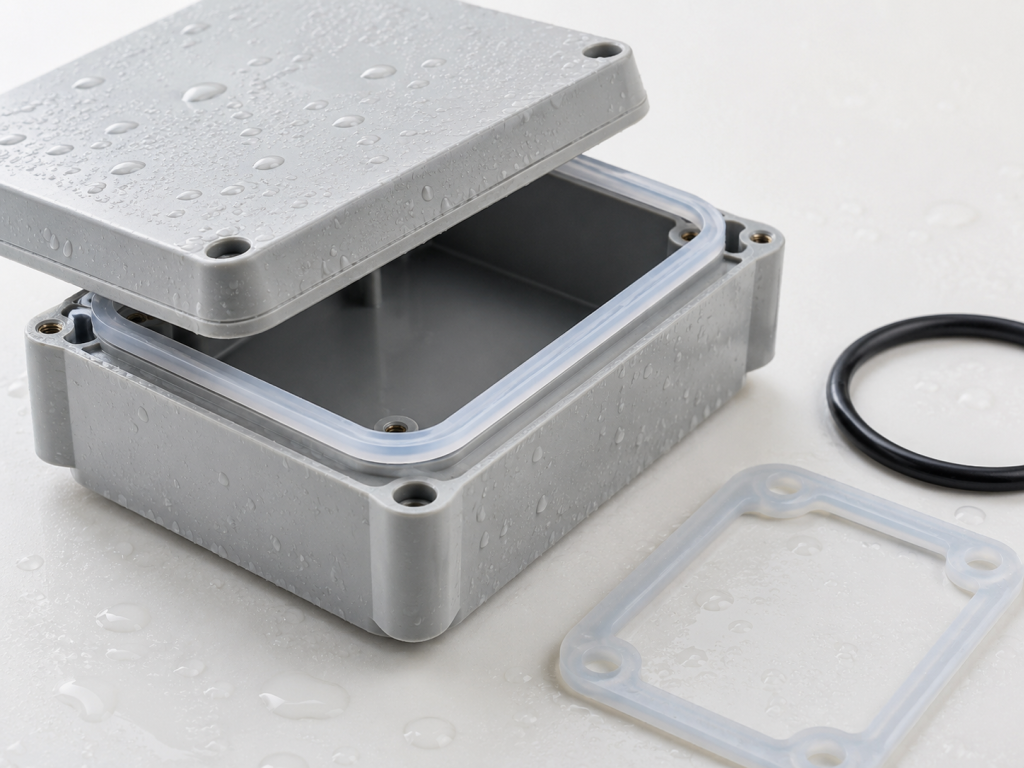
Co je to vodotěsné silikonové těsnění?
Vodotěsné silikonové těsnění je elastomerový díl, který zabraňuje pronikání vody nebo vlhkosti přes styčnou plochu mezi dvěma smontovanými díly.
Při správném stlačení silikon vyplní malé mezery, stopy po obrábění, odchylky ve formování a nerovnosti povrchu. Tím vzniká souvislý kontaktní tlak mezi těsněním a styčnými plochami.
Mezi běžné vodotěsné silikonové těsnicí prvky patří:
- Silikonové O-kroužky
- Ploché silikonové těsnění
- Obdélníkové těsnicí kroužky
- Těsnění ve tvaru písmene D
- Těsnění rtové
- Duté silikonové těsnění
- Radiální hřídelová těsnění
- Těsnění konektorů
- Těsnění kabelových průchodů
- Tlačítkové membrány
- Silikonová těsnění s přetvarovaným obalem
- Těsnění krytů vyráběná na míru
Správná konstrukce těsnění závisí na tom, zda je daná aplikace vystavena dešti, stříkající vodě, dočasnému ponoření, trvalému ponoření, tlakovému mytí, kondenzaci, páře nebo vnitřnímu tlaku kapaliny.
„Vodotěsný“ neznamená totéž pro každé použití
Před výběrem silikonového těsnění by měl kupující přesně definovat, co pro hotový výrobek znamená pojem “vodotěsný”.
Těsnění určené pouze k ochraně před deštěm nemusí vydržet ponoření do vody. Těsnění, které obstojí v krátké zkoušce postřikem, může i přesto začít prosakovat po teplotních cyklech nebo dlouhodobém stlačení.
Mezi důležité podmínky pro podání žádosti patří:
- Směr rozstřiku vody
- Tlak vody
- Hloubka ponoření
- Doba ponoření
- Četnost expozice
- Provozní teplota
- Tepelné cykly
- Vnitřní nebo vnější tlak
- Hnutí za bydlení
- Očekávaná životnost
- Metody čištění
- Vystavení chemickým látkám
Požadovaná úroveň ochrany by měla být stanovena ještě před zahájením výroby nástrojů.
Běžné provedení vodotěsných silikonových těsnění
Silikonové O-kroužky
O-kroužky mají kruhový průřez a obvykle se montují do obrobených nebo lisovaných drážek.
Často se používají k:
- Kryty snímačů
- Potrubní armatury
- Ventilové sestavy
- Kryty baterií
- Elektrické konektory
- Válcové skříně
- Součásti čerpadla
O-kroužek může zajistit spolehlivé vodotěsné utěsnění, pokud drážka reguluje stlačení a zabraňuje nadměrnému pohybu.
O-kroužky jsou obzvláště účinné v kruhových nebo symetrických sestavách. Mohou se však zkroutit, srolovat, natáhnout nebo posunout, pokud drážka a postup montáže nejsou správně navrženy.
Ploché silikonové těsnění
Ploché silikonové těsnění se stlačuje mezi dvěma styčnými plochami. Často se používá v obdélníkových krytech, panelech, víkách a skříních.
Mezi typické oblasti použití patří:
- Venkovní elektrické skříně
- Industrial control panels
- Lighting housings
- Appliance covers
- Inspection windows
- Equipment doors
Flat gaskets provide a large sealing area and can accommodate irregular housing shapes. However, the fastener positions and clamping force must be distributed evenly.
If screws are too far apart, the housing may bend between fastening points and create local leakage paths.
Rectangular and Square-Section Seals
Rectangular profiles offer a wide, stable contact surface and are less likely to roll during assembly.
These seals are useful for:
- Shallow grooves
- Large enclosure covers
- Plastic housings
- Static industrial assemblies
- Parts requiring controlled positioning
The design should provide enough space for lateral material expansion during compression.
D-Shaped Seals
D-shaped seals have a flat mounting side and a curved compression surface.
They are commonly used for:
- Access doors
- Equipment cabinets
- Outdoor housings
- Vehicle enclosures
- Protective covers
The flat base helps stabilize the seal, while the rounded upper surface provides controlled deformation.
D-shaped seals may be molded as closed rings or produced from extruded profiles with bonded joints.
Lip Seals
A lip seal uses one or more thin flexible edges to maintain sealing contact.
Lip seals are useful when:
- Assembly force must remain low
- The mating surface moves
- Radial sealing is required
- A secondary dust barrier is needed
- The housing has limited space
The sealing lip must be protected from folding, tearing, or excessive compression during assembly.
Hollow Silicone Seals
Hollow silicone profiles compress more easily than solid gaskets. They are often used when a large seal is required but the housing cannot withstand high clamping force.
Mezi typické oblasti použití patří:
- Large equipment doors
- Thin plastic covers
- Glass panels
- Lightweight enclosures
- Battery compartment covers
The hollow cavity, wall thickness, corner geometry, and joint strength must be carefully controlled.
Overmolded Waterproof Seals
Silicone can be directly molded onto plastic, metal, cable, connector, or electronic components.
Overmolding can reduce assembly steps and eliminate separate gasket installation.
Common examples include:
- Waterproof cable connectors
- Kryty snímačů
- Electronic buttons
- Cable-entry components
- Plastic covers with integrated gaskets
- Metal inserts with silicone sealing surfaces
The design must consider adhesion, substrate preparation, material compatibility, undercuts, mechanical locking features, and molding temperature.
Selecting the Silicone Material
Silicone materials differ in hardness, tear strength, compression set, chemical resistance, curing system, cleanliness, and regulatory status.
General-Purpose Silicone
General-purpose silicone is suitable for many outdoor and industrial waterproofing applications.
It offers good resistance to:
- Water
- Ozone
- Ultraviolet exposure
- Weathering
- High and low temperatures
It is commonly used in lighting, electrical housings, appliances, and general equipment.
Tekutý silikonový kaučuk
Liquid silicone rubber, or LSR, is suitable for precision injection molding and high-volume production.
Advantages include:
- Consistent dimensions
- Stable material mixing
- Complex sealing geometry
- Thin sealing lips
- Automated molding
- Low-flash tooling
- Plastic or metal overmolding
LSR is often selected for connectors, sensors, medical devices, electronic components, and precision waterproof seals.
High-Consistency Rubber
High-consistency rubber, also called HCR, can be compression molded, transfer molded, or extruded.
It is suitable for:
- Large gaskets
- Thick sealing rings
- Extruded door seals
- Low- to medium-volume projects
- Těsnění na míru
The best manufacturing method depends on part size, tolerance, annual volume, and profile complexity.
Fluorosilikon
Fluorosilicone provides improved resistance to certain fuels, oils, and solvents.
It may be required for waterproof seals used in:
- Automotive systems
- Aerospace equipment
- Fuel-related assemblies
- Oil-exposed industrial components
However, fluorosilicone is generally more expensive than standard silicone.
Food-Contact or Medical Silicone
Applications involving food, drinking water, or medical devices may require controlled material formulations and supporting documentation.
The buyer should specify:
- Intended contact conditions
- Applicable regulations
- Sterilization method
- Color restrictions
- Cleanliness requirements
- Traceability requirements
- Required test reports
A general description such as “food-grade” or “medical-grade” is not sufficient without defining the applicable standard and use conditions.
How Silicone Hardness Affects Waterproofing
Silicone hardness is commonly measured using the Shore A scale.
Typical waterproof sealing applications may use materials between approximately 30 and 70 Shore A, although softer or harder materials may be selected for specialized designs.
Softer Silicone
Softer silicone can conform more easily to uneven or low-rigidity mating surfaces.
Possible benefits include:
- Lower assembly force
- Better conformity
- Improved sealing on textured surfaces
- Greater tolerance of housing variation
Mezi možné nevýhody patří:
- Higher risk of extrusion
- Greater installation distortion
- Lower dimensional stability
- Increased risk of over-compression
- More difficult automated handling
Harder Silicone
Harder silicone provides better shape retention and may be easier to position during assembly.
Possible benefits include:
- Improved dimensional stability
- Better resistance to extrusion
- Easier automated installation
- More controlled geometry
Mezi možné nevýhody patří:
- Higher clamping force
- Reduced conformity
- Greater sensitivity to housing flatness
- Leakage if compression is insufficient
Hardness should not be selected independently. It must be evaluated together with the seal profile and compression target.
Understanding Seal Compression
Compression is one of the most important factors in waterproof seal design.
When the housing is assembled, the seal must be compressed enough to create continuous contact pressure around the full sealing path.
Insufficient Compression
Insufficient compression may cause:
- Local gaps
- Low sealing pressure
- Water entry
- Dust penetration
- Seal movement
- Leakage after vibration
- Failure during thermal cycling
Excessive Compression
Excessive compression may cause:
- High assembly force
- Permanent deformation
- Housing distortion
- Seal extrusion
- Accelerated compression set
- Tearing during assembly
- Reduced service life
The ideal compression percentage depends on:
- Seal profile
- Tvrdost materiálu
- Static or dynamic application
- Groove fill
- Temperature
- Tlak
- Surface condition
- Housing rigidity
- Assembly tolerance
A moderate initial compression target may be used during early design, but final values should be validated using the actual molded parts and housings.
Groove Design Considerations
The groove controls the position, compression, and expansion of the silicone seal.
A properly designed groove should:
- Keep the seal in position
- Prevent twisting or rolling
- Allow lateral expansion
- Control compression
- Minimize assembly damage
- Maintain continuous sealing pressure
- Prevent excessive extrusion
Important groove dimensions include:
- Groove width
- Groove depth
- Corner radius
- Entry chamfer
- Povrchová úprava
- Parting-line position
- Compression stop
- Clearance gap
The groove should not be completely filled by the uncompressed seal. Silicone must have room to deform when the parts are assembled.
Sharp groove corners should generally be avoided because they can damage the seal or create stress concentration.
Housing Flatness and Rigidity
Even a correctly designed gasket can leak if the housing bends or the mating surfaces are not flat.
This problem is common in:
- Large plastic covers
- Thin metal panels
- Long rectangular housings
- Enclosures with widely spaced screws
- Components assembled with inconsistent torque
Engineers should evaluate:
- Housing wall thickness
- Rib design
- Fastener spacing
- Screw torque
- Cover deflection
- Surface flatness
- Warpage after molding
- Thermal expansion
Adding more compression does not always solve housing deformation. Excessive gasket force may make the distortion worse.
Fastener Position and Assembly Force
For flat gaskets, fastener placement directly affects sealing pressure.
If screws are placed only at the corners, the center of a long edge may lift and create a leakage path.
The assembly should provide:
- Even fastener spacing
- Controlled torque
- Adequate housing stiffness
- Compression stops where necessary
- Consistent clamping pressure
Compression stops are rigid features that limit how far the housing can close. They can help prevent gasket over-compression and improve assembly consistency.
Surface Finish and Sealing Interfaces
The mating surface should be smooth enough to prevent continuous leak channels.
Potential problems include:
- Deep machining marks
- Sink marks
- Parting lines
- Ejector-pin marks
- Scratches
- Flash
- Weld lines
- Kontaminace povrchu
- Housing warpage
The seal should not cross an uncontrolled parting line, sharp edge, or deep surface defect.
For critical applications, the drawing should identify the sealing surface and its required finish.
Corners and Joint Areas
Corners are common failure locations in rectangular waterproof gaskets.
Problems may include:
- Seal thinning
- Incomplete filling
- Uneven compression
- Material folding
- Stress concentration
- Bonded-joint weakness
Molded closed-loop gaskets generally provide better corner consistency than cut-and-bonded extruded profiles.
When an extruded gasket is joined into a ring, the buyer should specify:
- Joint position
- Joint strength
- Maximum mismatch
- Joint appearance
- Leak-test requirements
- Minimum cross-sectional consistency
Compression Set and Long-Term Performance
Compression set describes the permanent deformation remaining after silicone has been compressed for a defined time and temperature.
A seal with poor compression-set performance may gradually lose contact pressure.
This is especially important in:
- Outdoor equipment
- Hot enclosures
- Automotive systems
- Battery assemblies
- Lighting products
- Long-life industrial equipment
- Products that are rarely serviced
The material should be tested under conditions that reflect the real operating temperature and compression level.
Room-temperature test data alone may not predict long-term sealing performance.
Thermal Cycling
Silicone, plastic, metal, and glass expand and contract at different rates.
During temperature cycling, these dimensional changes can alter gasket compression and housing flatness.
A seal may pass an initial leak test but fail after repeated heating and cooling.
Thermal cycling evaluation should consider:
- Minimum temperature
- Maximum temperature
- Heating rate
- Cooling rate
- Number of cycles
- Dwell time
- Assembly condition
- Internal pressure
- Moisture exposure
Leak testing after thermal cycling is often more meaningful than testing only newly assembled parts.
Waterproof Seal Leak-Testing Methods
There is no single leak test suitable for every application. The test method should match the actual risk and product specification.
Visual Water Spray Testing
The assembly is exposed to water spray from specified directions.
This method is suitable for:
- Rain-resistant housings
- Outdoor products
- General splash protection
- Early prototype evaluation
After testing, the enclosure is opened and inspected for water entry.
The procedure should control:
- Spray pressure
- Nozzle distance
- Spray angle
- Duration
- Product orientation
- Water temperature
Immersion Testing
The assembled product is submerged in water for a specified depth and time.
Immersion testing is appropriate for:
- Waterproof sensors
- Battery housings
- Submersible equipment
- Portable electronics
- Sealed connectors
The test specification should define:
- Water depth
- Exposure duration
- Product orientation
- Water temperature
- Internal pressure condition
- Acceptance criteria
Air-Pressure Decay Testing
The sealed assembly is pressurized with air. The system then measures the pressure decrease over time.
Advantages include:
- Clean testing
- Fast production inspection
- Quantitative results
- Easy automation
- No need to dry the product
However, pressure-decay results can be influenced by:
- Internal volume
- Temperature change
- Flexible housing expansion
- Fixture leakage
- Stabilization time
The test limits must be developed using known good and known leaking samples.
Vacuum Decay Testing
Vacuum decay testing removes air from a test chamber or component and measures pressure changes.
It can detect small leaks and may be suitable for sensitive components.
Fixture design and test-volume stability are important for repeatability.
Bubble Leak Testing
The component is pressurized and submerged in water. Escaping air produces visible bubbles.
This method is useful for locating leak positions during development.
It is simple but may be less suitable for automated production testing or very small leaks.
Tracer-Gas Testing
A tracer gas such as helium may be used for highly sensitive leak detection.
This method is generally reserved for applications requiring very low allowable leak rates.
It may be used in:
- Medical systems
- High-reliability electronics
- Aerospace components
- Vakuové systémy
- Specialized industrial equipment
Tracer-gas testing requires specialized equipment and controlled procedures.
Dye Penetration Testing
Colored water or fluorescent liquid can help identify the path of water entry.
This is useful during failure analysis but may contaminate the assembly.
Creating a Leak-Test Specification
A useful leak-test requirement should define more than “no leakage.”
It should include:
- Test method
- Test pressure
- Water depth
- Test duration
- Product orientation
- Stabilization time
- Allowable pressure loss
- Allowable leak rate
- Inspection method
- Sample quantity
- Test frequency
- Environmental conditioning
- Pass/fail criteria
The test method should be agreed upon before mass production.
Prototype Validation
Waterproof sealing performance should be validated using production-intent materials and geometry.
A practical validation sequence may include:
- Dimensional inspection of the seal and groove
- Assembly-force measurement
- Initial leak testing
- Tepelné cykly
- Vibration testing
- Mechanical shock testing
- Vystavení chemickým látkám
- Aging evaluation
- Repeat leak testing
- Final visual inspection
Prototype testing should also cover tolerance extremes.
A design that works only with nominal dimensions may fail during mass production.
Manufacturing Quality Requirements
Potential manufacturing defects in waterproof silicone seals include:
- Excessive flash
- Short molding
- Air bubbles
- Tears
- Contamination
- Surface dents
- Parting-line mismatch
- Incorrect hardness
- Poorly bonded joints
- Dimensional variation
- Distorted profiles
- Damaged sealing lips
Inspection requirements may include:
- Rozměrové měření
- Shore A hardness testing
- Vizuální kontrola
- Kontrola materiálu
- Compression-set testing
- Joint-strength testing
- Leak testing
- Lot traceability
- Color verification
- Kontrola obalů
The sealing surface should be protected from dust, deformation, sharp tools, and unsuitable packaging.
Information to Include in a Waterproof Seal RFQ
To receive an accurate quotation and engineering review, provide:
- Two-dimensional drawing
- Three-dimensional model
- Seal profile
- Critical dimensions
- Rozměry drážky
- Housing material
- Tvrdost silikonu
- Required material grade
- Provozní teplota
- Water exposure conditions
- Vnitřní nebo vnější tlak
- Target protection level
- Vystavení chemickým látkám
- Assembly method
- Fastener torque
- Annual order quantity
- Sample quantity
- Regulatory requirements
- Leak-test method
- Inspection and packaging requirements
Photos or drawings of the final assembly can help the supplier identify potential sealing risks before tooling.
How to Choose a Waterproof Silicone Seal Supplier
A suitable supplier should be able to support more than part molding.
Important capabilities include:
- Seal profile design review
- Výběr materiálu
- Compression analysis
- Groove review
- Tooling development
- Prototype molding
- Vstřikování LSR
- Lisování pod tlakem
- Silicone extrusion
- Overmolding
- Kontrola rozměrů
- Leak testing
- Sledovatelnost materiálu
- Failure analysis
Before approving tooling, ask the supplier to review the sealing path, compression ratio, groove fill, parting-line location, corner design, and assembly process.
Závěr
Reliable waterproof performance is created by the complete sealing system, not by silicone material alone.
The seal profile, hardness, groove geometry, compression, housing stiffness, fastener spacing, surface quality, temperature exposure, and assembly process must work together.
Industrial procurement engineers should define the actual water exposure conditions and required leak-testing method before requesting quotations.
A well-designed silicone seal should be tested after thermal cycling, mechanical stress, aging, and tolerance variation—not only immediately after assembly.
Early engineering review and clear validation requirements can reduce water-ingress failures, shorten development time, and improve long-term product reliability.
Často kladené otázky
What silicone hardness is suitable for waterproof seals?
Many waterproof sealing applications use silicone between 30 and 70 Shore A. Softer materials conform more easily, while harder materials provide greater dimensional stability. The final hardness should be validated with the actual groove and housing.
How much should a silicone gasket be compressed?
The required compression depends on the profile, hardness, groove, housing, temperature, and pressure. Too little compression may leak, while excessive compression can damage the seal or distort the housing.
Can silicone seals be used outdoors?
Yes. Silicone generally offers good resistance to ultraviolet exposure, ozone, temperature variation, and weathering. The exact formulation should still be selected according to the operating environment.
Why does a waterproof enclosure leak near the screws?
The housing may be bending between fasteners, or the gasket compression may be uneven. Fastener spacing, torque, housing rigidity, and gasket geometry should be reviewed.
Is an immersion test enough to validate a waterproof seal?
Not always. The product may also need thermal cycling, vibration, aging, pressure testing, and repeat leak testing to confirm long-term reliability.
What is the best leak test for mass production?
Air-pressure decay testing is commonly used because it is clean, fast, quantitative, and suitable for automation. The correct method depends on the product volume, allowable leak rate, and internal geometry.
Are molded gaskets better than bonded extruded gaskets?
Molded closed-loop gaskets generally provide better corner and joint consistency. Extruded and bonded gaskets may be more economical for large sizes, but the joint must be carefully controlled and tested.
Can silicone be overmolded directly onto plastic?
Yes. LSR can be overmolded onto compatible plastics or mechanically locked to the substrate. Adhesion performance depends on the plastic type, silicone formulation, surface preparation, and part design.
 English
  Japanese
  Korean
  German
  French
  Italian
  Spanish
  Dutch
Dutch  Chinese
  Portuguese
  Polish
  Czech
Czech  Hungarian
  Swedish
  Finnish
  Vietnamese
  Thai
Thai  Turkish
  Arabic
  Russian