
Baby products require some of the highest safety standards among consumer goods. Materials used in products that come into contact with infants must be carefully selected to ensure they are non-toxic, durable, hygienic, and comfortable.
In recent years, Liquid Silicone Rubber (LSR) has become one of the preferred materials for premium baby products due to its excellent biocompatibility, softness, temperature resistance, and manufacturing precision.
From baby bottle nipples and feeding accessories to teethers and infant care products, LSR provides unique advantages that traditional plastics and other elastomers cannot easily achieve.
This article explains why Liquid Silicone Rubber is ideal for baby products, including its material properties, safety advantages, manufacturing process, and common applications.
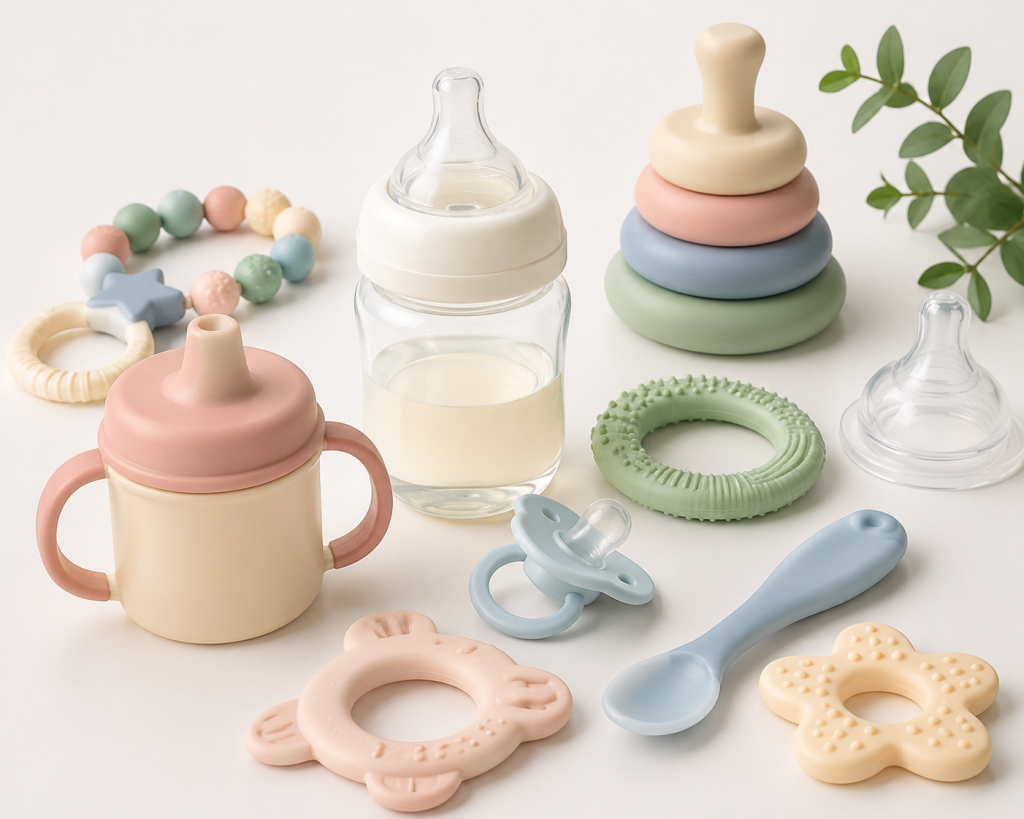
1. What Is Liquid Silicone Rubber (LSR)?
Liquid Silicone Rubber (LSR) is a high-purity silicone elastomer processed through precision injection molding.
Unlike traditional silicone materials supplied in solid form, LSR is delivered as two liquid components:
- Component A: Silicone polymer base
- Component B: Cross-linking agent with platinum catalyst
During manufacturing:
- The two components are mixed precisely.
- The liquid silicone is injected into a heated mold.
- The material cures into a flexible silicone product.
The process enables manufacturers to produce:
- Complex shapes
- Thin-wall structures
- Soft-touch surfaces
- High-precision components
This makes LSR especially suitable for products designed for infants.
2. Why Material Selection Is Critical for Baby Products
Babies have unique safety requirements compared with adults.
Baby products often need to withstand:
- Frequent contact with the mouth
- Repeated washing
- High-temperature sterilization
- Daily mechanical stress
A suitable material should provide:
Safety
- Free from harmful substances
- Low odor
- Stable chemical structure
المتانة
- Resistant to tearing
- Long service life
- Maintains performance after repeated use
Comfort
- Soft texture
- Gentle contact with delicate skin
النظافة
- Easy cleaning
- Resistance to bacteria accumulation
LSR meets many of these requirements, making it widely used in infant products.
3. Key Advantages of LSR for Baby Products
3.1 Excellent Food-Grade Safety
One of the biggest advantages of LSR is its suitability for food-contact applications.
High-quality LSR materials can comply with international safety requirements, including:
- FDA food-contact regulations
- EU food safety requirements
- BPA-free requirements
LSR does not typically contain:
- BPA
- Phthalates
- Heavy metals
- Harmful plasticizers
This makes it suitable for products that frequently contact:
- Milk
- Formula
- Baby food
3.2 Soft and Comfortable Texture
Infants have sensitive gums and skin.
LSR provides:
- Soft touch
- High elasticity
- Gentle deformation
Compared with hard plastic materials, silicone offers a more comfortable experience.
Applications:
- Baby bottle nipples
- Teething toys
- Pacifier components
- Feeding spoons
The softness of LSR helps simulate a more natural feeding experience.
3.3 Excellent Heat Resistance
Baby products require frequent sterilization.
Common sterilization methods include:
- Boiling water
- Steam sterilization
- Dishwasher cleaning
LSR maintains its properties under repeated heating cycles.
Typical performance:
- Working temperature:
- Approximately -50°C to +200°C
Benefits:
- No deformation during sterilization
- Stable mechanical properties
- Long product lifespan
3.4 Odorless and Taste Neutral
Babies are highly sensitive to smells and tastes.
Poor-quality materials may produce:
- Plastic odors
- Chemical smells
- Unpleasant taste
Medical and food-grade LSR provides:
- Low odor
- Neutral taste
- Clean user experience
This is especially important for:
- Bottle nipples
- Feeding accessories
- Silicone cups
3.5 High Durability and Tear Resistance
Baby products experience repeated mechanical stress.
Examples:
- Babies biting teethers
- Repeated squeezing of nipples
- Frequent bending of soft parts
LSR provides:
- Excellent elasticity
- مقاومة التمزق
- Compression recovery
This improves product reliability and reduces replacement frequency.
3.6 Easy Cleaning and Hygiene
The smooth surface of LSR provides excellent hygiene advantages.
Benefits:
- Low water absorption
- Easy washing
- Resistance to stains
Compared with porous materials, silicone surfaces are less likely to retain:
- Food residues
- الرطوبة
- Odors
This makes LSR suitable for products requiring frequent cleaning.
4. Common Baby Products Made with LSR
4.1 Baby Bottle Nipples
Baby bottle nipples are one of the most common LSR applications.
Requirements:
- النعومة
- الانتعاش المرن
- Safe contact with milk
- Resistance to sterilization
LSR allows manufacturers to control:
- Nipple shape
- معدل التدفق
- السماكة
- النعومة
4.2 Silicone Teething Toys
During teething periods, babies need safe chewing products.
LSR teethers provide:
- Soft gum-friendly texture
- Safe chewing experience
- Easy cleaning
Design advantages:
- Complex shapes
- Comfortable grip structures
- Multiple textures
4.3 Pacifiers
Pacifiers require:
- High purity materials
- Soft mouth contact
- Long-term durability
LSR provides:
- Stable performance
- Comfortable feel
- Reliable safety
4.4 Baby Feeding Accessories
وتشمل التطبيقات ما يلي:
- Silicone spoons
- Silicone bowls
- أكواب من القش
- Feeding valves
Advantages:
- Heat resistance
- Soft edges
- Food safety
4.5 Infant Healthcare Products
LSR is also used in:
- Baby thermometers
- Nasal aspirator components
- Healthcare accessories
Its flexibility and safety make it suitable for sensitive applications.
5. LSR Manufacturing Process for Baby Products
Producing baby-grade LSR products requires strict manufacturing control.
Step 1: Product Design
Engineers consider:
- Infant safety
- Ergonomics
- Cleaning requirements
- Material thickness
Important design factors:
- Rounded edges
- Smooth surfaces
- No sharp corners
Step 2: Mold Development
High-quality molds are essential for baby products.
Mold design focuses on:
- تشطيب السطح
- دقة الأبعاد
- Flash control
For infant products, excessive flash must be avoided because it may affect safety and comfort.
Step 3: LSR Injection Molding
The manufacturing process includes:
- Mixing two liquid silicone components
- Injecting into precision molds
- Heat curing
- Removing finished products
Advantages:
- High consistency
- Automated production
- Reduced contamination risk
Step 4: Quality Inspection
Baby product manufacturers typically perform:
Appearance Inspection
Checking:
- عيوب السطح
- اتساق الألوان
- Flash
Material Testing
Including:
- اختبار الصلابة
- Tensile testing
- Aging testing
Safety Testing
Including:
- Food contact testing
- Chemical analysis
- Biological safety evaluation
6. Design Considerations for LSR Baby Products
6.1 Safety-Oriented Structure Design
Designers should avoid:
- Sharp edges
- Small detachable parts
- Difficult-to-clean structures
Preferred designs:
- Rounded corners
- Integrated structures
- Smooth surfaces
6.2 Appropriate Silicone Hardness
Different products require different hardness levels.
Examples:
| Product | Typical Requirement |
|---|---|
| Baby nipple | Soft silicone |
| Teether | Medium-soft silicone |
| Bowl and spoon | Medium hardness |
Hardness selection affects:
- Comfort
- المتانة
- User experience
6.3 Color Selection
Baby products often use attractive colors.
High-quality silicone pigments should provide:
- Stability
- Safety
- Long-lasting appearance
7. How to Choose an LSR Baby Product Manufacturer
When selecting a silicone supplier, brands should evaluate:
Material Capability
Supplier should provide:
- سيليكون مخصص للاستخدام الغذائي
- Medical-grade silicone options
- Material certificates
Manufacturing Capability
Important capabilities include:
- القولبة بالحقن باستخدام مادة LSR
- Precision tooling
- Automated production
مراقبة الجودة
A reliable supplier should have:
- Strict inspection procedures
- Batch traceability
- Quality documentation
Product Development Support
Experienced manufacturers can help with:
- Product design optimization
- تطوير النماذج الأولية
- Mold improvement
- الإنتاج الضخم
8. Future Trends of LSR Baby Products
The baby product industry is moving toward:
Safer Materials
Increasing demand for:
- سيليكون مخصص للاستخدام الغذائي
- Medical-grade silicone
- Sustainable materials
Smart Baby Products
Integration of:
- Sensors
- Temperature monitoring
- Connected feeding systems
requires advanced silicone solutions.
Personalized Designs
LSR manufacturing enables:
- Custom shapes
- Multiple colors
- Brand-specific designs
This helps brands create differentiated products.
الخلاصة
Liquid Silicone Rubber (LSR) has become an ideal material for baby products because of its excellent safety, softness, durability, heat resistance, and hygienic properties.
From baby bottle nipples and teethers to feeding accessories and healthcare products, LSR enables manufacturers to create products that are safer, more comfortable, and more reliable for infants.
For baby product brands and startups, choosing an experienced LSR silicone manufacturer is essential. A professional supplier can provide support from product design and mold development to quality control and mass production.
As parents continue to demand safer and higher-quality baby products, Liquid Silicone Rubber will remain a key material driving innovation in the infant care industry.
 English
  Japanese
  Korean
  German
  French
  Italian
  Spanish
  Dutch
Dutch  Chinese
  Portuguese
  Polish
  Czech
Czech  Hungarian
  Swedish
  Finnish
  Vietnamese
  Thai
Thai  Turkish
  Arabic
  Russian