
Medical Liquid Silicone Rubber (LSR) is widely used in catheters, respiratory devices, surgical instruments, wearable medical products, seals, and implantable components due to its excellent biocompatibility, flexibility, and chemical resistance. However, before these products reach hospitals or patients, they often undergo one or more sterilization processes that can significantly affect their appearance—particularly their color.
For many medical device manufacturers, color is not merely cosmetic. It serves as a critical identification feature for product size, application, orientation, and brand recognition. Even a slight color change after sterilization may lead to customer rejection, production delays, or expensive requalification.
This guide explains how to validate medical LSR colors after Ethylene Oxide (EO), Gamma Irradiation, and Steam (Autoclave) Sterilization, covering testing methods, acceptance criteria, documentation, and production control.
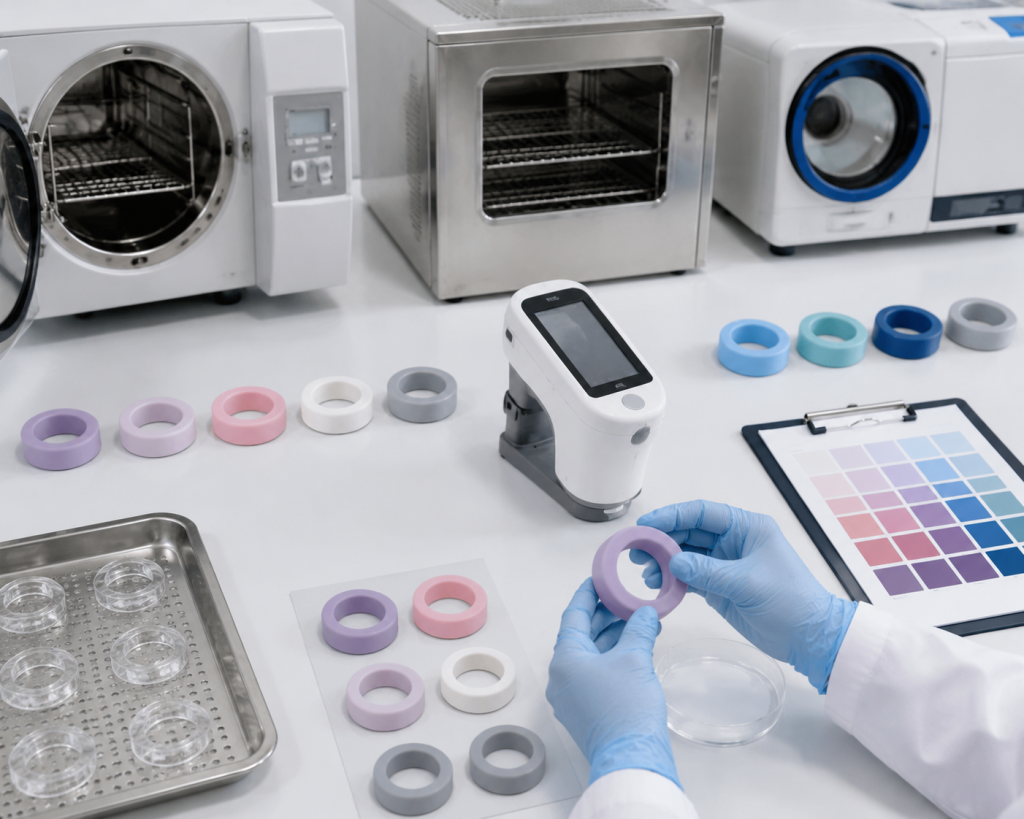
Table of Contents
- Why Sterilization Validation Matters
- Common Sterilization Methods
- How Sterilization Affects LSR Colors
- Preparing Color Validation Samples
- Color Measurement Methods
- Validation After EO Sterilization
- Validation After Gamma Irradiation
- Validation After Steam Sterilization
- Accelerated Aging Verification
- Documentation and Acceptance Criteria
- Best Practices
- الأسئلة الشائعة
- الخلاصة
Why Sterilization Validation Matters
Unlike consumer silicone products, medical LSR components must maintain consistent appearance throughout their service life.
Color validation helps ensure:
- Reliable product identification
- Batch-to-batch consistency
- Regulatory compliance
- Customer confidence
- Stable brand appearance
- Reduced manufacturing risk
A color that changes significantly after sterilization may create confusion during clinical use or fail customer approval standards.
Common Sterilization Methods
Medical silicone products are commonly sterilized using one of the following methods.
| Sterilization Method | Typical Conditions | Primary Effect on LSR |
|---|---|---|
| EO (Ethylene Oxide) | 37–55°C, high humidity | Minimal thermal stress |
| Gamma Irradiation | 25–50 kGy | High-energy radiation exposure |
| Steam (Autoclave) | 121–134°C | High temperature and moisture |
| E-beam (optional) | High-energy electrons | Similar to gamma but shorter exposure |
Each method affects pigments differently, making validation essential.
How Sterilization Affects LSR Colors
Color changes are influenced by several factors:
Pigment Stability
Some pigments tolerate radiation well, while others fade or darken.
Possible effects include:
- Yellowing
- Whitening
- Color fading
- Increased opacity
- Loss of saturation
Silicone Base Material
The transparency and formulation of the LSR also affect color stability.
For example:
- Transparent LSR may show yellowing more easily.
- Filled silicone can mask slight color shifts.
- Platinum-cured LSR generally offers better long-term stability.
Product Geometry
Wall thickness influences perceived color.
Thicker sections may appear darker after sterilization due to light transmission changes.
Preparing Validation Samples
Validation should use production-representative samples.
Recommended preparation includes:
- Final production tooling
- Production-grade LSR
- Actual pigment formulation
- Standard molding parameters
- Normal packaging configuration
Testing laboratory samples that differ from production conditions may produce misleading results.
Establishing a Baseline
Before sterilization, record:
- High-resolution photographs
- Spectrophotometer measurements
- L*, a*, b* values
- Delta E baseline
- Surface gloss
- Transparency
- Material batch number
- Pigment lot number
This baseline becomes the reference for post-sterilization evaluation.
Measuring Color Changes
Objective measurement is essential.
Typical equipment includes:
- Spectrophotometer
- Colorimeter
- Standard D65 light cabinet
Important parameters include:
| Measurement | الوصف |
|---|---|
| L* | Lightness |
| a* | Red–Green axis |
| b* | Yellow–Blue axis |
| ΔE | Overall color difference |
Most manufacturers combine instrument measurements with trained visual inspection.
EO Sterilization Validation
EO sterilization is generally considered the least aggressive toward pigments.
Validation typically includes:
- Color measurement before sterilization
- EO sterilization cycle
- Aeration period
- Color re-measurement
- الفحص البصري
- Mechanical inspection
Typical observations:
- Minimal color shift
- No significant fading
- Excellent pigment stability
- Suitable for most medical colors
Potential concerns include slight discoloration if moisture-sensitive pigments are used.
Gamma Sterilization Validation
Gamma irradiation introduces high-energy photons that can alter pigment chemistry.
Validation steps include:
- Baseline measurement
- Gamma exposure (commonly 25–50 kGy)
- Immediate inspection
- Seven-day stabilization period
- Repeat color measurement
- Mechanical property verification
Typical changes may include:
- Yellowing
- Blue fading
- Red darkening
- White discoloration
Pigments should always be qualified specifically for gamma exposure.
Steam Sterilization Validation
Steam sterilization combines:
- High temperature
- High humidity
- Pressure
Repeated autoclave cycles are particularly demanding.
Validation should include:
- Single-cycle testing
- Multiple-cycle testing (e.g., 10, 25, 50, or customer-specified cycles)
- Color measurements after each stage
- Visual comparison with the approved reference
Typical observations:
| Number of Cycles | Expected Evaluation |
|---|---|
| 1 | Initial validation |
| 10 | Short-term durability |
| 25 | Medium-term stability |
| 50 | Long-term reusable device evaluation |
Accelerated Aging Validation
Some devices require additional aging studies.
Common evaluations include:
- Elevated temperature storage
- High humidity exposure
- UV exposure (if applicable)
- Long-term shelf-life simulation
Color measurements are repeated after aging to verify long-term stability.
Visual Inspection Standards
Color should be evaluated under standardized conditions.
Recommended environment:
- D65 daylight simulator
- Neutral gray background
- Standard viewing angle
- Controlled viewing distance
- Clean sample surface
Avoid evaluating colors under ordinary office lighting, as different light sources can alter perceived color.
Acceptance Criteria
Each project should establish clear acceptance limits.
Typical criteria may include:
| Parameter | Example Requirement |
|---|---|
| ΔE | Customer-defined acceptance limit |
| Visual Difference | No obvious visible discoloration |
| Surface Appearance | No stains, spots, or uneven coloration |
| Transparency | No significant change |
| Identification Color | Clearly distinguishable |
Acceptance values should always be agreed upon between supplier and customer.
Documentation Requirements
A complete validation package typically includes:
- Material certification
- Pigment information
- Sterilization records
- Color measurement reports
- Visual inspection records
- Sample photographs
- Process parameters
- Batch traceability
- Validation summary
Good documentation simplifies regulatory audits and customer approvals.
Production Monitoring
Once validation is complete, manufacturers should continue monitoring production.
Recommended controls include:
- Incoming pigment inspection
- التحقق من المواد الخام
- First Article Inspection (FAI)
- Routine Delta E measurements
- Golden sample comparison
- Batch record review
- Periodic sterilization revalidation
Continuous monitoring reduces the risk of unexpected color variation.
Common Validation Mistakes
Avoid these common errors:
- Validating only before sterilization
- Ignoring multiple sterilization cycles
- Using laboratory instead of production samples
- Measuring under uncontrolled lighting
- Changing pigment suppliers after validation
- Skipping aging studies
- Failing to document process parameters
Best Practices
- Select pigments specifically designed for medical silicone.
- Validate colors using the intended sterilization method.
- Combine instrument measurements with visual inspection.
- Retain approved golden samples.
- Control pigment and material lot traceability.
- Monitor production color regularly.
- Include aging studies when required.
- Revalidate after significant material or process changes.
الأسئلة الشائعة
Does EO sterilization usually change LSR colors?
EO generally has the least impact on medical LSR colors, although sensitive pigments should still be validated.
Which sterilization method causes the greatest color change?
Gamma irradiation and repeated steam sterilization typically present the highest risk of color shift, depending on the pigment system.
Should Delta E be measured immediately after sterilization?
It is good practice to measure immediately and again after an appropriate stabilization period, particularly for radiation sterilization.
Can one pigment formulation be used for all sterilization methods?
Not always. Some pigments perform well under EO but show unacceptable changes after gamma or repeated autoclave cycles.
Is visual inspection sufficient?
No. Instrument-based color measurement should always complement visual evaluation.
How often should sterilization validation be repeated?
Revalidation is recommended after significant changes to the silicone grade, pigment formulation, molding process, sterilization process, or when required by customer or regulatory requirements.
Can repeated autoclave cycles affect reusable medical devices?
Yes. Multiple steam sterilization cycles may gradually change both color and mechanical properties, so reusable products should be validated over the expected number of sterilization cycles.
Why are production samples preferred for validation?
Production samples better represent actual manufacturing conditions, ensuring that validation results accurately reflect the final commercial product.
الخلاصة
Validating medical LSR colors after EO, gamma irradiation, and steam sterilization is an essential part of medical device development. Sterilization can influence pigment stability, silicone transparency, and overall appearance, making a structured validation process critical for maintaining product quality and regulatory compliance.
By establishing baseline measurements, selecting sterilization-resistant pigments, performing objective color measurements, conducting accelerated aging studies, and maintaining robust production controls, manufacturers can achieve consistent, repeatable color performance throughout the product lifecycle. A comprehensive validation strategy not only reduces development risks but also improves customer confidence and ensures that every production batch meets the visual and functional expectations of the medical industry.
 English
  Japanese
  Korean
  German
  French
  Italian
  Spanish
  Dutch
Dutch  Chinese
  Portuguese
  Polish
  Czech
Czech  Hungarian
  Swedish
  Finnish
  Vietnamese
  Thai
Thai  Turkish
  Arabic
  Russian