
Achieving an approved medical silicone color during product development is only the first step. The greater manufacturing challenge is reproducing that color consistently across different raw-material lots, production dates, machines, molds and sterilization batches.
Medical silicone color variation can result from seemingly minor changes in the silicone base, pigment concentration, mixing method, molding temperature, cure time, wall thickness or inspection environment. A color that met the approved standard during prototype production may appear lighter, darker or less saturated in a later production batch.
For ordinary consumer products, a small color difference may be treated as a cosmetic issue. In medical products, however, color may be used to identify component sizes, distinguish product families, indicate connection types or support clinical organization. Inconsistent color can therefore create customer complaints, inspection failures, rework, delayed shipments and potentially incorrect product identification.
Preventing batch-to-batch variation requires a controlled system covering raw materials, formulation, dosing, molding, sterilization, measurement, documentation and supplier change management.
This guide explains the major causes of medical silicone color variation and provides a practical manufacturing-control strategy for maintaining consistent color from pilot production through long-term mass production.
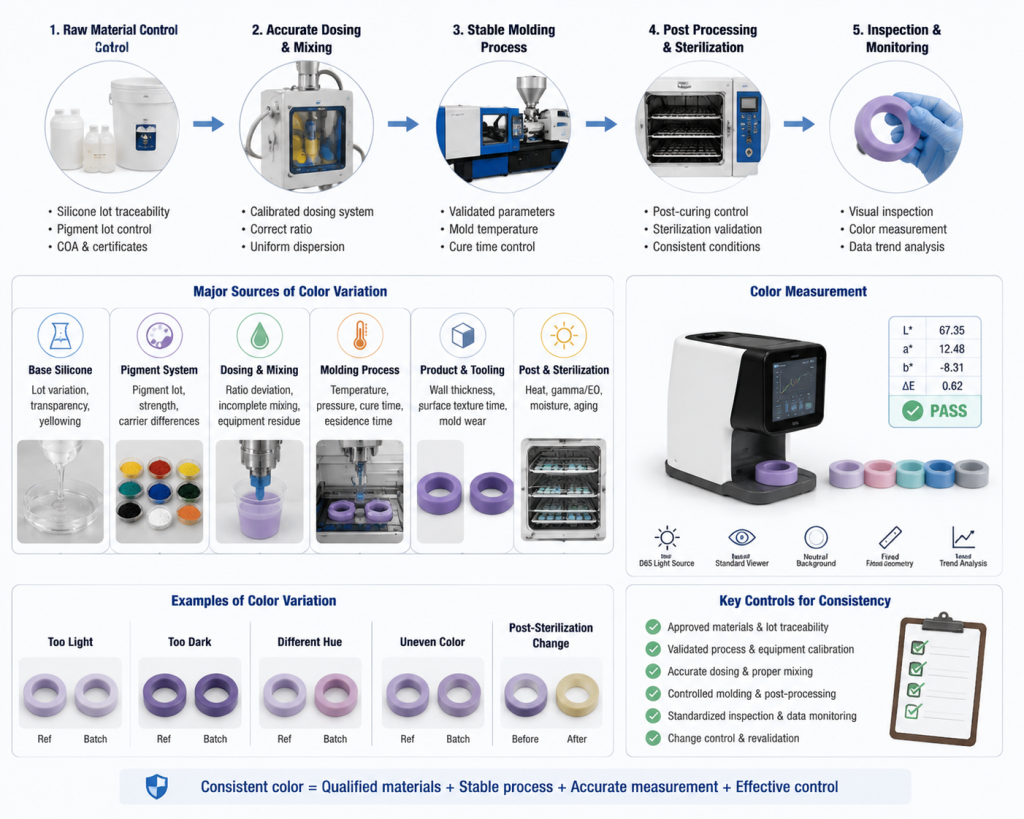
Table of Contents
- Why Color Consistency Matters in Medical Silicone
- What Is Batch-to-Batch Color Variation?
- Main Sources of Medical LSR Color Variation
- Base Silicone Lot Control
- Pigment and Color Masterbatch Control
- Accurate Pigment Dosing
- Mixing and Dispersion Control
- LSR Injection-Molding Parameters
- Product Design and Wall-Thickness Effects
- Mold Surface and Tooling Effects
- Post-Curing and Secondary Processes
- Sterilization-Related Variation
- Visual and Instrumental Color Inspection
- Establishing Delta E Acceptance Criteria
- Golden Samples and Reference Standards
- Production Sampling and Trend Analysis
- Supplier and Process Change Control
- Troubleshooting Common Color Problems
- RFQ and Production-Control Checklist
- الأسئلة الشائعة
- الخلاصة
Why Color Consistency Matters in Medical Silicone
Medical silicone components are produced in many colors, including white, transparent blue, gray, green, pink, red and customized brand colors.
Color may serve several practical functions:
- Differentiating component sizes
- Identifying product models
- Distinguishing flow paths
- Separating pediatric and adult products
- Indicating connection types
- Supporting assembly verification
- Organizing surgical instruments
- Identifying reusable and disposable components
- Maintaining OEM brand consistency
Examples include colored respiratory connectors, catheter components, medical seals, wearable-device parts, instrument handles and fluid-management components.
If two production batches look noticeably different, customers may question whether the material, formulation or manufacturing process has changed. Even when the parts remain mechanically acceptable, visible variation can reduce confidence in the supplier’s production controls.
For body-contacting medical devices, colorants must also be considered as part of the finished device formulation. FDA explains that biological evaluation considers the whole device rather than only the individual raw materials, and that suitability depends on the specific contact situation.
What Is Batch-to-Batch Color Variation?
Batch-to-batch variation means that products manufactured in separate production lots do not have the same visual or instrumentally measured color.
Variation may appear as differences in:
- Lightness
- Hue
- Saturation
- Opacity
- Transparency
- Gloss
- نسيج السطح
- Yellowing
- Whiteness
- Color uniformity
Typical examples include:
- One blue batch appears greener than the approved reference.
- A white silicone component becomes slightly yellow.
- A translucent pink part looks darker in a later batch.
- Components from different mold cavities have different shades.
- Parts appear acceptable before sterilization but differ afterward.
- The first production pieces differ from parts molded later in the run.
Some differences originate from the actual pigment formulation. Others are optical effects caused by thickness, texture, gloss or lighting.
The manufacturer must therefore distinguish between true color variation and apparent color variation.
Main Sources of Medical LSR Color Variation
Medical silicone color consistency can be affected by six major groups of variables.
| Control Area | Typical Sources of Variation |
|---|---|
| Base material | Silicone lot, transparency, catalyst ratio, filler level |
| Pigment system | Pigment lot, carrier, concentration, dispersion |
| Dosing and mixing | Ratio error, incomplete mixing, equipment residue |
| Molding process | Temperature, cure time, pressure, residence time |
| Product and tooling | Wall thickness, texture, cavity condition, venting |
| Post-processing | Post-curing, sterilization, cleaning, aging |
Color consistency cannot usually be maintained by final inspection alone. It must be built into the complete manufacturing process.
Base Silicone Lot Control
The base LSR provides the optical background for the final color.
Even uncolored silicone may vary slightly in:
- Transparency
- Natural tint
- Filler distribution
- Refractive properties
- Catalyst content
- Volatile content
- Post-curing behavior
A small change in the natural color of the base LSR may become visible in light, pastel, white or transparent formulations.
Recommended Base-Material Controls
Manufacturers should control:
- Silicone supplier
- Material trade name and grade
- Manufacturing location
- Lot number
- Shelf life
- Storage temperature
- Storage duration
- Container-opening date
- Part A and Part B lot combination
- Certificate of Analysis
Where possible, one production order should use material from the same qualified base-silicone lot.
When a lot change is unavoidable, the new lot should be compared against the approved formulation before full production begins.
Part A and Part B Control
Two-component LSR systems normally require a controlled mixing ratio.
An incorrect ratio may affect:
- Cure completeness
- مظهر السطح
- Transparency
- Mechanical properties
- Yellowing
- Post-curing behavior
The metering equipment should therefore be calibrated and monitored according to a documented maintenance schedule.
Pigment and Color Masterbatch Control
The pigment system is one of the most direct causes of color variation.
A medical silicone color masterbatch may contain:
- صبغة واحدة أو أكثر
- Silicone-compatible carrier material
- مواد مساعدة على التشتت
- Stabilizing ingredients
- Trace processing residues
Color consistency depends on both the pigment chemistry and the carrier system.
Pigment-Lot Variation
Pigments from different manufacturing lots may vary slightly in:
- Tint strength
- Particle size
- Purity
- الرطوبة
- Dispersion
- Shade
- Impurity profile
A small pigment-strength difference can produce a noticeable change when the target shade is light or translucent.
Recommended controls include:
- Approved pigment supplier
- Fixed pigment grade
- Lot traceability
- Certificate of Analysis
- Incoming color verification
- Retained raw-material samples
- Defined change-notification agreement
Color-Additive Regulatory Review
In the United States, certain medical-device color additives are subject to statutory color-additive provisions. FDA states that a device containing a color additive may be considered adulterated unless an applicable regulation lists the additive for its intended use.
Therefore, replacing an approved pigment with a visually similar alternative should not be treated as a simple purchasing change. The replacement may have a different composition, regulatory status or biological risk profile.
Accurate Pigment Dosing
Pigment concentration must be accurately controlled because small dosing errors can create visible color differences.
For example, a target formulation may use a masterbatch concentration of:
- 0.2%
- 0.5%
- 1.0%
- Another validated percentage
The exact dosage depends on:
- Pigment strength
- Desired opacity
- Base-silicone transparency
- Product thickness
- نسيج السطح
- Sterilization method
- Customer acceptance range
Common Dosing Problems
Typical causes of error include:
- Incorrect pump calibration
- Manual weighing mistakes
- Material remaining in hoses
- Unstable pump pressure
- Air bubbles in the dosing line
- Low pigment-container level
- Incorrect recipe selection
- Confusion between similar color codes
- Unauthorized adjustment by operators
Recommended Dosing Controls
A robust process may include:
- Automatic metered dosing
- Locked production recipes
- Barcode verification
- Calibrated weighing equipment
- Independent second-person verification
- Actual-versus-target ratio records
- Low-level pigment alarms
- Line-clearance procedures
- First-piece color inspection
For high-volume medical production, automatic dosing generally provides better repeatability than uncontrolled manual addition.
Mixing and Dispersion Control
Correct pigment concentration does not guarantee uniform color. The pigment must also be evenly dispersed.
Poor dispersion can cause:
- Streaks
- Swirls
- Dark spots
- Light spots
- Speckling
- Cavity-to-cavity differences
- Local opacity changes
Variables Affecting Dispersion
Dispersion is influenced by:
- Pigment viscosity
- Carrier compatibility
- Mixing-element design
- Static-mixer condition
- معدل التدفق
- Material temperature
- Back pressure
- Hose length
- Start-up waste quantity
- Equipment cleanliness
Static Mixer Control
A damaged, blocked or incorrectly installed static mixer may produce incomplete blending.
Manufacturers should define:
- Approved mixer type
- Mixer length
- Replacement interval
- Cleaning or disposal procedure
- Installation orientation
- Start-up purge quantity
The color should not be approved until the material flow has stabilized after start-up or material replacement.
Preventing Cross-Contamination
Residual pigment from a previous job can contaminate the next color.
This is particularly visible when changing:
- Black to white
- Red to transparent
- Blue to yellow
- Dark colors to pastel shades
Production controls should include:
- Dedicated pigment lines where practical
- Validated flushing quantities
- Equipment-cleaning procedures
- Color-change sequence planning
- Visual inspection of purge material
- Documented line clearance
White and transparent medical silicone products usually require especially strict contamination control.
LSR Injection-Molding Parameters
Molding conditions can change the appearance of colored LSR even when the formulation remains unchanged.
Important variables include:
- Mold temperature
- Injection pressure
- Injection speed
- Cure time
- Holding pressure
- Material temperature
- Residence time
- Cycle interruptions
- Cavity balance
Mold Temperature
Higher mold temperatures may:
- Accelerate curing
- Change surface gloss
- Increase yellowing in sensitive formulations
- Affect pigment appearance
- Create cavity-to-cavity variation if heating is uneven
The actual mold temperature should be monitored rather than relying only on the machine setpoint.
Cure Time
Insufficient cure may produce:
- Different gloss
- الأسطح اللزجة
- Incomplete color development
- Post-cure color drift
Excessive heat exposure may cause:
- Darkening
- Yellowing
- Loss of saturation
- Changes in transparency
Injection Speed and Pressure
Injection parameters can influence:
- Flow marks
- Weld lines
- نسيج السطح
- Air entrapment
- Pigment orientation
- Gloss variation
A color problem may therefore be associated with a filling problem rather than with the pigment formula itself.
Process Validation
The approved color should be demonstrated throughout the validated processing window, not only at one ideal machine setting.
The current US FDA Quality Management System Regulation became effective on February 2, 2026, and incorporates ISO 13485:2016 by reference into the medical-device quality-system framework.
For medical production, color-related parameters should therefore be managed within the manufacturer’s documented quality and process-control system.
Product Design and Wall-Thickness Effects
Silicone color appearance depends strongly on product geometry.
سماكة الجدار
A translucent part usually appears:
- Lighter in thin sections
- Darker in thick sections
- More saturated where material accumulates
- Less transparent around ribs and bosses
For this reason, flat color plaques may not accurately represent the final medical component.
Color approval should preferably use:
- Actual molded components
- A representative prototype tool
- Plaques matching the final wall thickness
- Samples with the intended texture
Uneven Thickness
Large thickness transitions may create visible shade differences within the same component.
Design changes that can improve appearance include:
- More uniform wall thickness
- Gradual transitions
- Reduced material accumulation
- Relocation of ribs
- Optimized gate placement
Part Orientation
Transparent and translucent silicone can appear different depending on:
- Viewing angle
- Background
- Lighting
- Part orientation
- Curved geometry
Inspection conditions should therefore be standardized.
Mold Surface and Tooling Effects
Surface finish changes how light is reflected and can significantly affect perceived color.
A glossy surface usually appears:
- Darker
- More saturated
- More reflective
A matte or textured surface may appear:
- Lighter
- Softer
- Less saturated
Tooling Variables
Color appearance may vary because of:
- Different cavity polish levels
- Mold wear
- Tool repair
- Texture inconsistency
- Residue on the mold surface
- Release-agent contamination
- Uneven venting
- Uneven cavity temperature
For multicavity tools, samples from each cavity should be evaluated during qualification.
A cavity-specific color difference should not automatically be corrected by changing the pigment formula. The tooling and process should be investigated first.
Post-Curing and Secondary Processes
Post-curing may be used to reduce volatile substances or stabilize certain silicone properties.
However, additional heat exposure may change:
- اللون
- Transparency
- Yellowing
- Gloss
- Surface feel
Post-curing controls should include:
- Oven identification
- Temperature
- Time
- Air circulation
- Load quantity
- Part arrangement
- Cooling conditions
All samples used for color approval should undergo the same post-curing process as the production parts.
Cleaning Processes
Cleaning agents or processes may also influence appearance.
Potential causes include:
- Solvent residues
- Water spots
- Detergent residues
- Abrasion
- Surface swelling
- Incomplete drying
The approved inspection stage should be clearly defined, such as:
- After molding
- After post-curing
- After cleaning
- After sterilization
- After final packaging
Sterilization-Related Variation
A medical silicone color may be consistent after molding but change after sterilization.
Common sterilization methods include:
- Ethylene oxide
- Gamma irradiation
- E-beam
- Steam or autoclave processing
EO Sterilization
EO normally exposes the product to lower temperatures than steam processing, but variation may still arise from:
- Humidity
- Aeration time
- التغليف
- Residual sterilant
- Preconditioning differences
Color should be evaluated after a defined aeration or stabilization period.
Gamma Irradiation
Gamma irradiation may cause:
- Yellowing
- Fading
- Darkening
- Delayed color change
- Loss of transparency
Variation may occur when batches receive different radiation doses within the validated dose range.
The color study should therefore consider:
- Minimum dose
- Nominal dose
- Maximum dose
- Immediate measurement
- Delayed measurement
- Accelerated aging
Steam Sterilization
Steam exposes silicone to heat, pressure and moisture.
Reusable components may gradually change after repeated cycles.
Validation may include measurements after:
- 1 cycle
- 10 cycles
- 25 cycles
- 50 cycles
- Maximum claimed reuse cycles
The exact test plan should reflect the device’s intended use.
Visual and Instrumental Color Inspection
Reliable color control requires both visual assessment and instrument measurement.
Visual Inspection
Visual inspection is useful for detecting:
- Streaks
- Spots
- Uneven dispersion
- Contamination
- عيوب السطح
- Obvious shade differences
Recommended viewing conditions include:
- Standardized light source
- Neutral background
- Defined viewing distance
- Defined viewing angle
- Clean sample surface
- Trained inspectors
Ordinary office lighting should not be used as the only approval environment.
Instrumental Measurement
A spectrophotometer can measure color using values such as:
- L*: lightness
- a*: red-green direction
- b*: yellow-blue direction
- Delta E: total color difference
Instrumental measurement reduces dependence on individual visual perception.
However, the measurement method must be controlled.
Important factors include:
- Measurement aperture
- Instrument geometry
- Calibration
- Sample thickness
- Number of readings
- Sample orientation
- Backing material
- نسيج السطح
- Instrument model
A transparent silicone part measured against a white background may produce different results from the same part measured against a black background.
The method should therefore be documented and repeated consistently.
Establishing Delta E Acceptance Criteria
Delta E represents the numerical difference between a test sample and a reference color.
A smaller Delta E normally indicates a closer match, but there is no single universal acceptance limit for all medical silicone products.
The appropriate tolerance depends on:
- اللون
- Transparency
- Product function
- تشطيب السطح
- Measurement method
- Customer expectations
- Whether color is cosmetic or functional
A practical specification may include:
| Control Item | Example Requirement |
| Visual appearance | No obvious difference from approved sample |
| Delta E | Customer-defined maximum |
| L*, a*, b* | Defined target and tolerance |
| السطح | No streaks, spots or contamination |
| Transparency | Within approved range |
| Sterilized color | Within post-sterilization limit |
The final acceptance limits should be agreed upon before mass production.
Why Delta E Alone Is Not Enough
Two parts can have a similar Delta E value but differ visibly in:
- Gloss
- Transparency
- الملمس
- Local color uniformity
Instrumental measurements should therefore be combined with visual inspection and physical-reference comparison.
Golden Samples and Reference Standards
A golden sample is an approved physical component retained as the production color reference.
A useful golden-sample system should define:
- رقم القطعة
- Color code
- Silicone grade
- Pigment formula
- Approval date
- Customer approval
- Sterilization status
- Storage conditions
- Replacement date
- Applicable revision
Protecting Golden Samples
Silicone samples may change over time because of:
- UV exposure
- Heat
- الغبار
- Chemical contact
- Aging
- Repeated handling
Golden samples should be stored:
- Away from direct sunlight
- In clean protective packaging
- At controlled temperature
- Away from chemicals
- With limited handling
Instrumental target values should be retained in addition to physical samples because the sample itself may gradually change.
Multiple Reference Samples
Manufacturers may retain:
- Master golden sample
- Production-floor working sample
- Quality-laboratory sample
- Customer sample
- Sterilized approved sample
The master sample should remain protected and should not be used for routine handling.
Production Sampling and Trend Analysis
Color consistency should be monitored throughout the production run.
A typical sampling plan may include:
- First-off parts
- Start of each shift
- After material replacement
- After machine stoppage
- After process adjustment
- At defined production intervals
- Last-off parts
- Samples from each cavity
Color Trend Analysis
Recording L*, a*, b* and Delta E values allows the manufacturer to identify gradual drift before parts exceed the specification.
A trend may indicate:
- Pigment pump wear
- الجرعة غير الصحيحة
- Mold-temperature drift
- Material aging
- Mixer blockage
- Silicone-lot differences
- Instrument-calibration problems
Control charts can be used to monitor important color values over time.
The goal is not only to reject nonconforming parts but also to detect process movement early enough to prevent a large defective batch.
Supplier and Process Change Control
Medical color consistency depends on maintaining the validated material and process configuration.
Changes requiring formal assessment may include:
- Base-silicone supplier change
- Silicone-grade change
- Pigment supplier change
- Pigment-manufacturing-location change
- Pigment-carrier change
- Formulation adjustment
- Dosing-equipment change
- Static-mixer change
- Mold transfer
- New molding machine
- New production site
- Post-curing change
- Sterilization-method change
- Radiation-dose change
- Packaging-material change
ISO 10993-1 frames biological evaluation within a risk-management process, and the current 2025 edition continues that risk-based approach.
A material change that produces the same visible color may still alter the device’s chemical or biological profile. Therefore, color approval alone is not sufficient evidence that a substitute material is equivalent.
Supplier Change Notification
Supplier agreements should define:
- Advance notification period
- Types of reportable changes
- Required supporting data
- Lot-traceability expectations
- Requalification responsibilities
- Obsolescence notification
No material substitution should be made without documented review and approval.
Troubleshooting Common Color Problems
Problem 1: Entire Batch Is Too Light
Possible causes:
- Pigment concentration too low
- Incorrect pump calibration
- Base LSR more opaque
- Excessive dilution
- Thin product wall
- Matte surface
- Incorrect measurement background
Recommended actions:
- Verify raw-material codes.
- Check pigment ratio records.
- Calibrate the dosing system.
- Compare base-material lots.
- Confirm sample thickness and surface finish.
- Do not adjust the formula until the actual cause is identified.
Problem 2: Entire Batch Is Too Dark
Possible causes:
- Excess pigment
- Incorrect recipe
- Thick wall sections
- Glossy surface
- Excessive thermal exposure
- Pigment contamination from a previous run
Recommended actions:
- Review dosing records.
- Inspect pigment-line cleanliness.
- Compare molding temperature and cure time.
- Confirm part dimensions.
- Check material and pigment lot numbers.
Problem 3: Color Streaks or Swirls
Possible causes:
- Incomplete pigment mixing
- Damaged static mixer
- Material flow instability
- Air in the dosing system
- Incompatible pigment carrier
- Insufficient start-up purge
Recommended actions:
- Inspect and replace the mixer.
- Check pump pressure and material flow.
- Purge until the color stabilizes.
- Confirm pigment compatibility.
- Inspect dosing hoses for air or blockage.
Problem 4: Different Mold Cavities Have Different Shades
Possible causes:
- Uneven cavity temperature
- Different cavity surface finish
- Flow imbalance
- Venting differences
- Wall-thickness differences
- Mold contamination
Recommended actions:
- Measure each cavity separately.
- Check cavity temperature.
- Compare cavity polish and texture.
- Review filling balance.
- Inspect tooling before changing the color formula.
Problem 5: Color Changes After Gamma Sterilization
Possible causes:
- Radiation-sensitive pigment
- Base-LSR yellowing
- Dose variation
- Packaging interaction
- Delayed post-radiation reaction
Recommended actions:
- Compare minimum and maximum sterilization doses.
- Measure immediately and after storage.
- Test alternative qualified pigment systems.
- Evaluate the silicone base and pigment separately.
- Include aging in the validation plan.
Problem 6: White Silicone Gradually Yellows
Possible causes:
- Base-material aging
- Excessive curing temperature
- Extended post-curing
- Contamination
- Gamma irradiation
- UV exposure
- Storage conditions
Recommended actions:
- Review thermal history.
- Inspect the production and storage environment.
- Compare unpigmented control samples.
- Test the complete sterilization and aging sequence.
- Verify pigment and base-material stability.
Recommended Color-Control Plan
A practical medical silicone color-control plan can be divided into five stages.
Stage 1: Material Qualification
Confirm:
- Approved base LSR
- Approved pigment grade
- الوثائق التنظيمية
- Biological evaluation support
- Sterilization compatibility
- Supplier change-notification controls
Stage 2: Process Development
Establish:
- تركيز الصبغة
- Mixing method
- Dosing equipment
- Mold temperature
- Cure time
- Post-curing parameters
- Start-up purge requirements
Stage 3: Color Validation
Approve:
- Molded production-representative samples
- Visual standard
- Instrumental target
- Delta E tolerance
- Sterilized color
- Aged color where applicable
Stage 4: Production Monitoring
Control:
- Material lot numbers
- Pigment ratio
- Machine parameters
- Each mold cavity
- First-off and interval samples
- Trend data
- Nonconforming material
Stage 5: Lifecycle Management
Maintain:
- Golden samples
- Retained production samples
- Calibration records
- Supplier performance records
- Change-control documentation
- Revalidation plans
Medical Silicone Color RFQ Checklist
Customers can reduce development time by providing the following information:
- Medical-device application
- Part drawing or 3D model
- Silicone grade
- الصلابة
- Color reference
- Pantone, RAL or physical sample
- Transparent, translucent or opaque appearance
- سماكة جدار المنتج
- تشطيب السطح
- Number of mold cavities
- Intended sterilization method
- Sterilization dose or number of cycles
- Target markets
- Biological evaluation requirements
- Delta E tolerance
- Visual inspection conditions
- Annual production volume
- Required batch traceability
- Required Certificate of Analysis
- Packaging and cleanliness requirements
- Supplier change-notification requirements
Physical molded color samples are generally more useful than printed references because silicone thickness, transparency and texture significantly affect appearance.
Production Approval Checklist
Before mass production, confirm that the following items are approved:
- Base-silicone manufacturer and grade
- Pigment manufacturer and grade
- تركيز الصبغة
- Color formula revision
- Dosing-system settings
- Static-mixer specification
- Molding process window
- Post-curing conditions
- Cleaning process
- Sterilization conditions
- Golden sample
- Instrumental color values
- Delta E tolerance
- Visual-inspection method
- Sampling frequency
- Lot-traceability method
- Change-control procedure
- Nonconformance response plan
الأسئلة الشائعة
Why do medical silicone batches have slightly different colors?
Differences can result from silicone and pigment lots, dosing accuracy, mixing, cure conditions, wall thickness, surface finish, sterilization or inspection lighting.
Can one Pantone number guarantee identical silicone colors?
No. Pantone references are printed standards. Molded silicone appearance also depends on transparency, thickness, texture and lighting.
What is the best way to control LSR pigment concentration?
A calibrated automatic dosing system with locked recipes and recorded actual ratios normally provides better repeatability than uncontrolled manual mixing.
Is Delta E sufficient for medical silicone color approval?
No. Delta E should be used together with visual inspection, golden samples and checks for gloss, transparency, streaks and surface defects.
Should each mold cavity be measured separately?
Yes, particularly during tooling qualification and process validation. Cavity temperature, polish, flow and thickness differences may affect appearance.
Why can transparent silicone show greater variation?
Transparent components allow light to pass through the material. Small differences in pigment level, thickness, background and base-material clarity are therefore more visible.
Can we change pigment suppliers if the new color looks identical?
The change should undergo formal assessment. A visually identical pigment may have different chemistry, carrier materials, impurity levels, sterilization behavior or regulatory status.
When should medical silicone color be inspected?
Inspection may be required after molding, post-curing, cleaning, sterilization and aging. The final approval stage should reflect the condition in which the customer receives or uses the product.
How should golden samples be stored?
They should be protected from light, heat, dust, chemicals and repeated handling. Instrumental reference data should also be retained.
How can manufacturers reduce color variation during long production runs?
They should monitor pigment ratio, material lots, mixer condition, molding parameters, cavity performance and color-measurement trends throughout the run.
Does sterilization always change medical LSR color?
Not always, but the possibility depends on the silicone, pigment system, sterilization method, dose and number of cycles. Representative testing is necessary.
When is revalidation required?
Revalidation or documented risk assessment may be needed after changes to the silicone, pigment, carrier, supplier, production site, equipment, tooling, process, sterilization or device design.
الخلاصة
Preventing batch-to-batch variation in medical silicone requires more than matching the correct color during initial development.
Reliable color consistency depends on controlling the complete production system, including the base LSR, pigment masterbatch, dosing ratio, mixing equipment, molding parameters, tooling condition, product geometry, post-curing process, sterilization cycle and inspection method.
The most effective manufacturing programs combine:
- Qualified and traceable raw materials
- Accurate automatic pigment dosing
- Validated mixing and molding processes
- Production-representative color approval
- Visual and instrumental inspection
- Protected golden samples
- Statistical trend monitoring
- Formal supplier and process change control
Manufacturers should also remember that a visible color match does not prove that two pigment systems are chemically or biologically equivalent. For medical products, color changes and material substitutions must be evaluated within the device’s quality, risk-management and regulatory framework.
By establishing clear specifications and controlling every major source of variation, medical-device companies can maintain stable silicone colors across prototypes, validation batches and long-term mass production while reducing rework, customer complaints and regulatory risk.
 English
  Japanese
  Korean
  German
  French
  Italian
  Spanish
  Dutch
Dutch  Chinese
  Portuguese
  Polish
  Czech
Czech  Hungarian
  Swedish
  Finnish
  Vietnamese
  Thai
Thai  Turkish
  Arabic
  Russian