
1. مقدمة
The global pet care industry is rapidly expanding, with increasing demand for safe, durable, and environmentally friendly materials. Among various polymers, food-grade silicone has become a preferred material for pet care products due to its non-toxic, flexible, and long-lasting properties.
Typical applications include pet feeding bowls, lick mats, chew toys, grooming tools, and water dispensers. For OEM manufacturers, silicone provides a highly customizable and scalable solution for global brands.
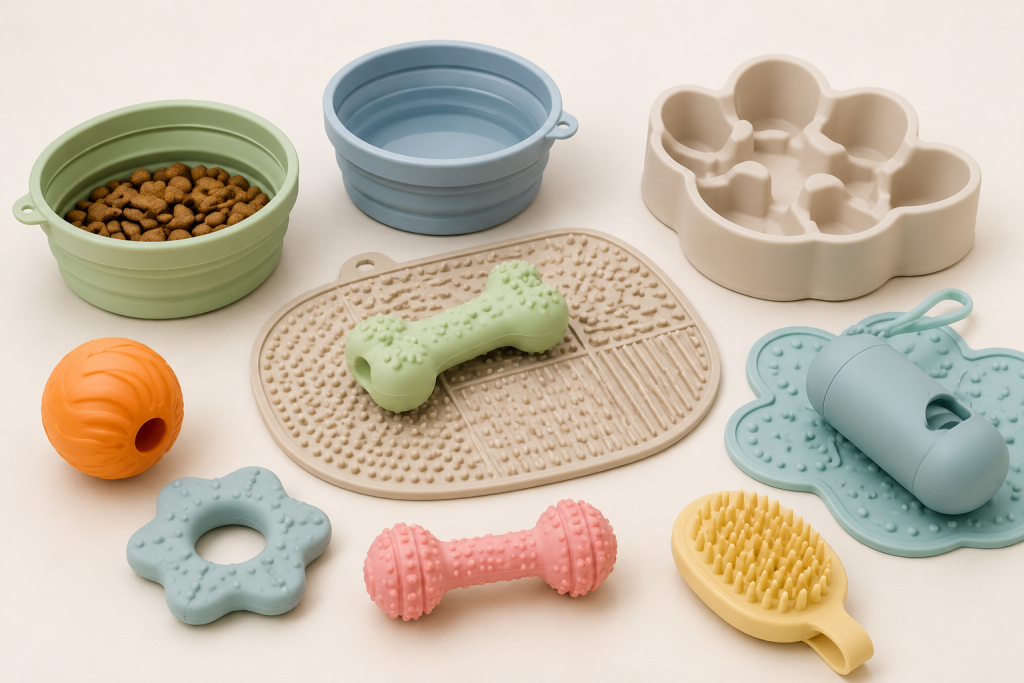
2. Why Food-Grade Silicone Is Ideal for Pet Products
Food-grade silicone offers several advantages over traditional materials such as plastic, rubber, or PVC:
- Non-toxic and BPA-free
- Odorless and tasteless
- High tear and bite resistance
- Temperature resistance (-40°C to 200°C)
- Easy to clean and dishwasher safe
- Long service life with minimal degradation
These properties make silicone particularly suitable for pet contact and chewing applications, where safety is critical.
3. Key Types of Silicone Pet Care Products
3.1 Silicone Pet Feeding Products
- Pet bowls (foldable or fixed design)
- Slow-feeder bowls
- Water dispensers
- Anti-spill feeding mats
These products require strong structural stability and non-slip design.
3.2 Silicone Chew Toys
- Bone-shaped toys
- Textured teething toys
- Interactive feeding toys
- Dental cleaning chew tools
Silicone chew toys must balance softness and durability to ensure safety while resisting aggressive biting.
3.3 Grooming and Care Products
- Silicone grooming brushes
- Bath cleaning gloves
- Massage pads
These products focus on comfort, flexibility, and ergonomic design.
4. Material Requirements for Pet-Grade Silicone
For OEM production, silicone materials must meet strict requirements:
4.1 Food-Grade Certification
- FDA compliant materials
- LFGB certification (for European markets)
4.2 Mechanical Performance
- High tear strength
- Compression resistance
- Long-term elasticity retention
4.3 Chemical Stability
- No harmful leaching
- Resistance to saliva, detergents, and pet fluids
- Stable under repeated cleaning cycles
5. Manufacturing Process Overview
5.1 Material Preparation
- Food-grade platinum-cured silicone preferred
- Pigments must be non-toxic and certified
5.2 LSR Injection Molding
Liquid Silicone Rubber (LSR) injection molding ensures:
- الإنتاج الضخم عالي الدقة
- Consistent product quality
- Complex geometry manufacturing capability
5.3 Post-Curing Process
- Removes volatile compounds
- Enhances odor neutrality
- Improves long-term safety performance
5.4 Surface Treatment
- أسطح مقاومة للانزلاق
- Matte or soft-touch finishes
- Custom logo embossing
6. Safety Considerations in Pet Product Design
6.1 Anti-Choking Design
Products must avoid:
- Small detachable parts
- Sharp edges
- Weak bonding structures
6.2 Bite Resistance Optimization
Engineers must balance:
- Softness (comfort for pets)
- Strength (durability under chewing force)
6.3 Hygiene and Cleanability
- Dishwasher-safe materials
- Non-porous silicone surfaces
- Resistance to bacterial growth
7. OEM/ODM Development Advantages
Working with a professional silicone OEM supplier provides:
خدمات تصنيع المعدات الأصلية (OEM)
- الإنتاج بناءً على رسومات العملاء
- الإنتاج الضخم المستقر
- Strict dimensional control
خدمات ODM
- Product design optimization
- Mold development
- الدعم في اختيار المواد
- أخذ عينات من النماذج الأولية
8. Applications in Global Pet Market
Food-grade silicone pet products are widely used in:
- Pet retail brands
- Veterinary supply chains
- E-commerce platforms (Amazon, Shopify)
- Pet grooming services
- Outdoor pet equipment brands
9. Industry Trends
The silicone pet care industry is evolving toward:
- Eco-friendly recyclable silicone materials
- Multi-functional pet feeding systems
- Foldable and portable designs
- Smart feeding devices integration
- Customized OEM branding solutions
10. الخاتمة
Food-grade silicone has become one of the most important materials in modern pet care manufacturing. Its combination of safety, durability, and flexibility makes it ideal for a wide range of pet products.
For OEM manufacturers and brands, success depends on material certification, structural design, and precision manufacturing capability, especially using advanced LSR injection molding processes.
 English
  Japanese
  Korean
  German
  French
  Italian
  Spanish
  Dutch
Dutch  Chinese
  Portuguese
  Polish
  Czech
Czech  Hungarian
  Swedish
  Finnish
  Vietnamese
  Thai
Thai  Turkish
  Arabic
  Russian