
Silicone has become one of the most widely used elastomer materials in modern manufacturing due to its excellent flexibility, temperature resistance, chemical stability, and long service life. From medical devices and baby products to kitchenware and food-contact components, silicone materials provide reliable performance in applications where safety and durability are essential.
However, not all silicone materials are the same.
When developing a new product, engineers and manufacturers often need to choose between السيليكون الطبي and food grade silicone. Although both materials are designed for safe applications, they have different performance requirements, testing standards, manufacturing controls, and intended uses.
Selecting the correct silicone material is critical because it directly affects product safety, regulatory compliance, user experience, and product lifespan.
This article explains the key differences between medical silicone and food grade silicone, helping product designers, engineers, and buyers understand how to choose the right material for different applications.
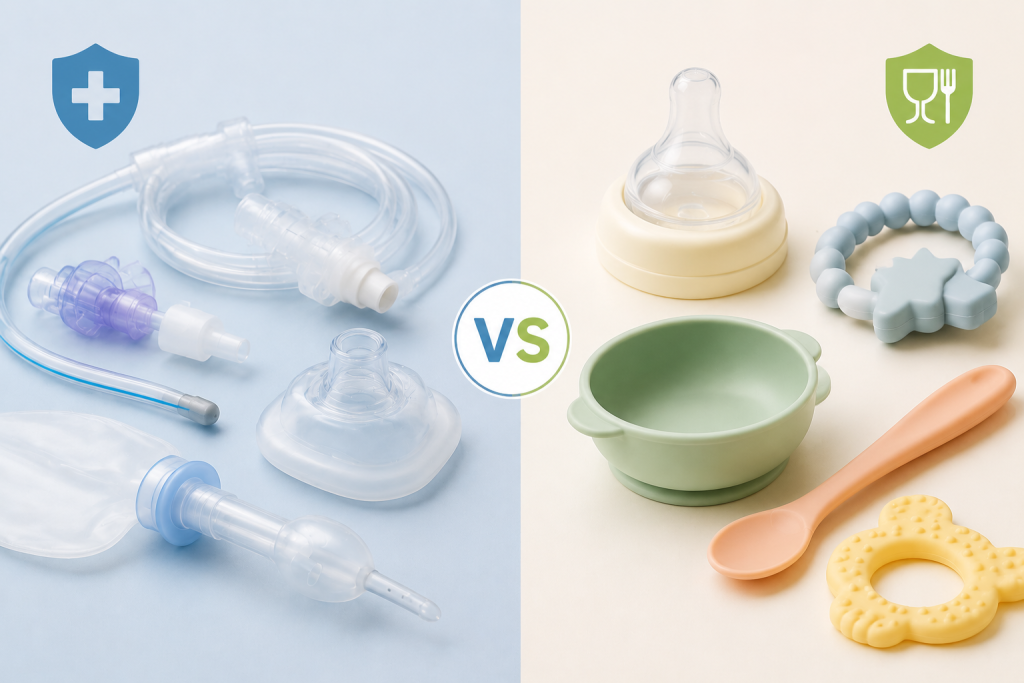
1. What Is Silicone Material?
Silicone is a synthetic elastomer based on silicone polymers, with a molecular structure consisting mainly of silicon and oxygen bonds.
This unique chemical structure gives silicone several advantages compared with traditional rubber and plastic materials:
- مقاومة ممتازة للحرارة
- High flexibility and elasticity
- Low chemical reactivity
- UV and ozone resistance
- Long-term aging stability
- Good electrical insulation properties
Silicone materials can maintain stable performance under extreme environmental conditions, making them suitable for demanding industries such as healthcare, food processing, electronics, automotive, and industrial manufacturing.
Depending on formulation, curing method, and manufacturing requirements, silicone can be developed into different grades, including:
- Medical grade silicone
- Food grade silicone
- Industrial grade silicone
- Electronic grade silicone
Among these, medical silicone and food grade silicone are two of the most commonly used safety-oriented silicone materials.
2. What Is Medical Grade Silicone?
Medical grade silicone is a high-purity silicone material specifically developed for healthcare and medical applications.
Unlike ordinary silicone materials, medical silicone must meet stricter requirements regarding:
- Biological compatibility
- Chemical purity
- Sterilization resistance
- Long-term stability
- Manufacturing traceability
Medical grade silicone is designed for products that may contact the human body, including skin, tissues, body fluids, or medical solutions.
تشمل التطبيقات النموذجية ما يلي:
- Catheter components
- Medical tubing
- Respiratory device parts
- Surgical components
- Medical seals
- Drug delivery components
- Wearable healthcare devices
Medical silicone is widely used because it combines softness, durability, and safety, making it suitable for both disposable and reusable medical products.
3. What Is Food Grade Silicone?
Food grade silicone is a silicone material developed for applications involving direct contact with food and beverages.
The main purpose of food grade silicone is to ensure that the material does not release harmful substances during normal use.
Common applications include:
- Baby bottle nipples
- Silicone teethers
- Baking molds
- Silicone kitchen tools
- Food storage containers
- Drinking cup accessories
Food grade silicone is valued for:
- Non-toxic characteristics
- Odorless performance
- Heat resistance
- Easy cleaning
- Long service life
It is widely used in household products and baby care products where safety and user comfort are important.
4. Key Differences Between Medical Silicone and Food Grade Silicone
Although medical silicone and food grade silicone share many similarities, they differ in their application requirements and testing standards.
4.1 Different Application Purposes
The biggest difference between medical silicone and food grade silicone is their intended use.
| المواد | Main Applications |
|---|---|
| Medical Grade Silicone | Medical devices, healthcare equipment, body-contact applications |
| السيليكون المخصص للاستخدام الغذائي | Food containers, baby products, kitchen accessories |
Medical silicone focuses on biological safety and interaction with the human body.
Food grade silicone focuses on safe contact with food and beverages.
4.2 Differences in Safety Requirements
Medical silicone requires more comprehensive biological safety evaluation because medical devices may directly interact with the human body.
Common medical silicone testing includes:
- Cytotoxicity testing
- Sensitization testing
- Irritation testing
- Acute toxicity testing
- Implantation testing
These tests evaluate whether the material may cause harmful reactions in biological environments.
Food grade silicone mainly focuses on food-contact safety requirements, including:
- Chemical migration testing
- Heavy metal testing
- Odor testing
- Food-contact compliance testing
Although both materials require safety evaluation, medical silicone generally faces stricter requirements.
4.3 Differences in Purity Requirements
Medical applications typically require higher material purity.
Medical silicone manufacturing requires strict control of:
- Raw material quality
- Additives
- Processing environment
- Contamination control
This is especially important for:
- الأجهزة القابلة للزرع
- Invasive medical products
- Long-term body-contact components
Food grade silicone also requires high purity but is primarily evaluated based on food safety requirements rather than biological implantation performance.
4.4 Differences in Sterilization Performance
Medical devices often need repeated sterilization during their service life.
Medical grade silicone is designed to withstand sterilization methods such as:
Autoclave Sterilization
High-temperature steam sterilization is commonly used for reusable medical equipment.
Typical conditions:
- 121°C–134°C
Gamma Radiation Sterilization
Commonly used for:
- Disposable medical products
- Sterile packaging
Ethylene Oxide (EtO) Sterilization
Used for heat-sensitive medical devices.
Medical silicone must maintain:
- Mechanical strength
- Elasticity
- Surface integrity
Food grade silicone also has good heat resistance but is usually designed for conditions such as:
- Boiling water
- Microwave heating
- Dishwasher cleaning
- Oven applications
4.5 Differences in Manufacturing Control
Medical silicone production usually requires stricter manufacturing control.
Important factors include:
- Clean production environment
- Batch traceability
- Material documentation
- Process validation
Manufacturers producing medical silicone components often follow quality systems such as:
- ISO 13485 medical device quality management system
Food grade silicone manufacturing focuses more on:
- Food safety compliance
- Material certification
- Production cleanliness
5. Similarities Between Medical Silicone and Food Grade Silicone
Despite their differences, both materials share many excellent silicone characteristics.
5.1 Temperature Resistance
Both medical and food grade silicone provide excellent thermal stability.
Typical operating range:
- Approximately -50°C to +200°C
This allows silicone products to maintain performance during:
- Heating
- Cooling
- التعقيم
- Environmental temperature changes
5.2 Chemical Stability
Both materials have good resistance against:
- الرطوبة
- Oxidation
- UV radiation
- Many chemicals
This improves product durability and service life.
5.3 Flexibility and Elasticity
Silicone provides excellent elastic recovery.
Benefits include:
- Soft touch
- Comfortable use
- Resistance to deformation
This makes silicone suitable for:
- Baby products
- Wearable devices
- Medical interfaces
6. Applications Comparison
Medical Silicone Applications
Medical grade silicone is commonly used in:
Medical Tubing
Examples:
- Catheter tubes
- Drainage systems
- Respiratory tubing
Requirements:
- Flexibility
- Chemical stability
- Biocompatibility
Medical Connectors
Examples:
- Fluid connectors
- Sealing components
- Valve systems
Requirements:
- Leak resistance
- Precision performance
Wearable Healthcare Devices
Examples:
- أساور مراقبة الصحة
- Sensor covers
Requirements:
- Skin comfort
- Long-term durability
Food Grade Silicone Applications
Food grade silicone is widely used in:
Baby Products
Examples:
- Baby bottle nipples
- Teethers
- Feeding spoons
Requirements:
- النعومة
- Safety
- Heat resistance
Kitchen Products
Examples:
- Baking molds
- Cooking tools
- Storage containers
Requirements:
- Easy cleaning
- Temperature resistance
Drinkware Accessories
Examples:
- Silicone cup sleeves
- Straw components
- Sealing rings
Requirements:
- Flexibility
- Food-contact safety
7. How to Choose the Right Silicone Material?
Choosing between medical silicone and food grade silicone depends on the product requirements.
Choose Medical Grade Silicone When:
- The product contacts the human body
- Biological safety is critical
- Sterilization is required
- Medical regulations apply
- Long-term reliability is needed
Examples:
- Medical devices
- Healthcare components
- Surgical accessories
Choose Food Grade Silicone When:
- The product contacts food or beverages
- Consumer safety is the primary concern
- High-temperature kitchen use is required
- Baby product applications are involved
Examples:
- Baby feeding products
- Kitchen accessories
- Food storage products
8. Liquid Silicone Rubber (LSR) in Medical and Food Applications
Both medical silicone and food grade silicone can be manufactured using Liquid Silicone Rubber (LSR) injection molding technology.
LSR provides additional advantages:
- High production consistency
- Complex product design capability
- Automated manufacturing
- Excellent dimensional accuracy
Common LSR applications include:
Medical:
- Silicone valves
- Medical connectors
- Cable overmolded components
Food and baby products:
- Bottle nipples
- Silicone teethers
- Feeding accessories
For high-volume production requiring precision and repeatability, LSR molding is often the preferred manufacturing method.
9. How to Select a Reliable Silicone Manufacturer?
When sourcing silicone products, choosing the right manufacturer is essential.
Important evaluation factors include:
Material Capability
A professional supplier should provide:
- Medical grade silicone options
- Food grade silicone materials
- Material certification documents
Manufacturing Capability
Important equipment includes:
- LSR injection molding machines
- Precision molds
- Automated production systems
مراقبة الجودة
A reliable supplier should have:
- Material traceability
- فحص الأبعاد
- Performance testing
- Quality documentation
Engineering Support
Experienced silicone manufacturers can assist with:
- Product design optimization
- اختيار المواد
- Mold development
- Production improvement
10. Future Trends of Silicone Materials
The demand for high-quality silicone materials continues to increase.
Future trends include:
Growth of Medical Devices
Healthcare innovation requires:
- Smaller components
- More flexible materials
- Higher reliability
Expansion of Baby Care Products
Parents increasingly prefer:
- Safer materials
- Premium silicone products
- Durable reusable designs
Advanced Manufacturing Technology
LSR injection molding and automation will continue improving:
- Production efficiency
- Product consistency
- Manufacturing flexibility
الخلاصة
Medical grade silicone and food grade silicone are both high-performance silicone materials designed for safety-critical applications. However, they serve different purposes.
Medical silicone focuses on:
- Biocompatibility
- Sterilization resistance
- Healthcare applications
- Strict regulatory requirements
Food grade silicone focuses on:
- Food safety
- Consumer use
- Heat resistance
- Daily product applications
For product designers and manufacturers, selecting the correct silicone grade is essential for achieving product safety, performance, and market compliance.
With the continued growth of medical devices, baby products, and consumer goods, silicone materials—especially advanced Liquid Silicone Rubber (LSR)—will continue to play an important role in modern manufacturing.
 English
  Japanese
  Korean
  German
  French
  Italian
  Spanish
  Dutch
Dutch  Chinese
  Portuguese
  Polish
  Czech
Czech  Hungarian
  Swedish
  Finnish
  Vietnamese
  Thai
Thai  Turkish
  Arabic
  Russian