
Silicone products are widely used in modern industries due to their excellent environmental performance, flexibility, durability, and safety characteristics. As demand for high-performance materials continues to grow, silicone has become an important alternative to traditional rubber and plastic materials.
To better understand silicone products, it is essential to start from the raw materials and their classifications, properties, and manufacturing processes.
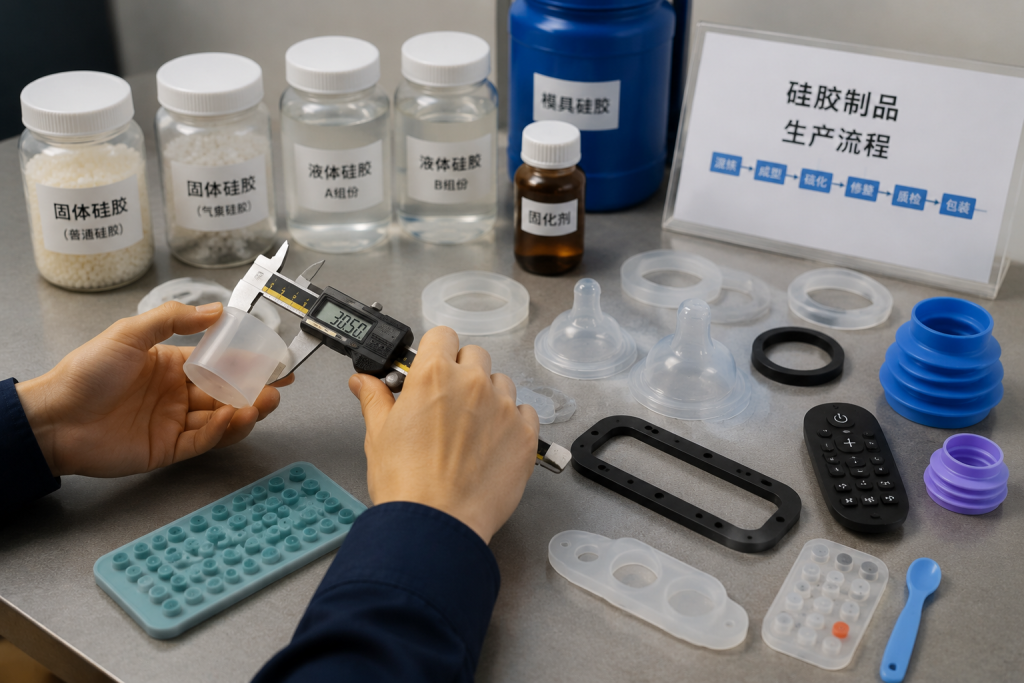
🧪 1. What Is Silicone Material?
Silicone is a synthetic elastomer made from silicon, oxygen, carbon, and hydrogen. It is processed from silicone gel into solid or liquid forms through different curing methods.
It features a porous molecular structure in some forms and is widely used as:
- A sealing material
- A molding material
- An insulating material
- A functional industrial material
Silicone is known for its stability, non-toxicity, and resistance to extreme environments.
🧱 2. Classification of Silicone Raw Materials
2.1 By Source (Domestic vs Imported Materials)
🔹 Domestic Silicone Materials
Common manufacturers include multiple industrial material suppliers in Asia, offering cost-effective solutions for general industrial applications.
🔹 Imported Silicone Materials
Widely used international brands include:
- Japan-based silicone materials
- US-based high-performance silicone materials
- European advanced polymer materials
Imported materials are typically used in high-end or medical-grade applications.
2.2 By Performance Type
🔹 Standard Silicone (Precipitated Silicone)
- Color: semi-transparent, milky white, light yellow, gray
- Hardness: 30–80 Shore A (commonly 40–70)
- Density: ~1.1–1.12 g/cm³
- Elongation: ~400%
Applications:
- Keypads
- Electronic accessories
- General industrial parts
- Conductive rubber products
🔹 High-Transparency Silicone (Vapor Phase Silicone)
- Color: transparent
- Hardness: 30–80 Shore A
- Elongation: 600%–700%
- High elasticity and strong tensile strength
Applications:
- Silicone tubing
- Protective covers
- High-end flexible components
2.3 By Physical Form
🔹 Solid Silicone
- Used in compression molding processes
- Suitable for:
- Silicone phone cases
- Kitchenware
- Keypads
- Industrial parts
🔹 Liquid Silicone Rubber (LSR)
- Flowable material before curing
- Used in injection molding
- Suitable for high-precision products such as:
- Baby nipples
- Medical components
- Silicone tubes
🧪 3. Types of Liquid Silicone Applications
Liquid silicone rubber can be classified into several functional categories:
🔹 Mold Making Silicone
Used for replica production and industrial molding applications.
🔹 Pad Printing Silicone
Used for transferring patterns onto irregular surfaces such as toys and electronics.
🔹 Electronic Potting Silicone
Used for sealing, waterproofing, shock absorption, and insulation of electronic components.
🔹 Prototype Silicone
Used for product design validation and model development.
🔹 Silicone Sealant (Silicone Glue)
Used in construction and sealing applications such as glass bonding and structural joints.
🔹 Baby & Medical Silicone
Used for safe-contact applications such as infant products and medical devices.
🔹 High-Temperature Silicone
Can withstand extreme temperatures ranging from 200°C to over 300°C in industrial applications.
⚙️ 4. Silicone Manufacturing Process Overview
A standard silicone production process includes:
- Material preparation
- Mixing and compounding
- Molding (compression or injection)
- Vulcanization (curing)
- Surface treatment (printing, coating, etc.)
- Trimming and finishing
- Packaging and inspection
🧠 5. Common Issues in Silicone Products
🔻 Non-recyclability after molding
Once silicone is formed, it cannot be reprocessed into raw material.
🔻 Printing durability issues
Silk-screen printing may fade if curing or surface treatment is not properly controlled.
🔻 Dimensional variation
Caused by pressure, temperature, or material feeding inconsistencies during molding.
🔻 Odor after production
A temporary smell may appear after molding due to curing heat, which usually disappears after a few days.
🧩 6. Advantages of Silicone Products
- Environmentally friendly and non-toxic
- Excellent elasticity and durability
- High temperature and low temperature resistance
- Long service life
- Suitable for mass production
- Wide range of industrial applications
📌 Conclusion
Silicone materials are highly versatile and play an important role across electronics, medical, automotive, household, and industrial sectors. Understanding material classification, processing methods, and application scenarios is essential for selecting the right silicone solution for different product requirements.
With continuous advancements in manufacturing technology, silicone products will continue to expand into more high-performance and precision applications.
 English
  Japanese
  Korean
  German
  French
  Italian
  Spanish
  Dutch
Dutch  Chinese
  Portuguese
  Polish
  Czech
Czech  Hungarian
  Swedish
  Finnish
  Vietnamese
  Thai
Thai  Turkish
  Arabic
  Russian