
In modern product development, silicone is widely used because of its excellent flexibility, temperature resistance, chemical stability, and long-term durability. However, when silicone needs to be combined with other materials such as plastics, metals, glass, or electronic components, manufacturers must choose the right joining method.
Two common approaches are:
- Överformning med silikon
- Adhesive Bonding
Both methods can create silicone-integrated products, but they have significant differences in manufacturing process, bonding performance, durability, production efficiency, and application suitability.
For engineers, product designers, and procurement teams, understanding the advantages and limitations of each method is essential for selecting the best manufacturing solution.
This article explains the differences between silicone overmolding and adhesive bonding, helping product developers determine which method is more suitable for their applications.
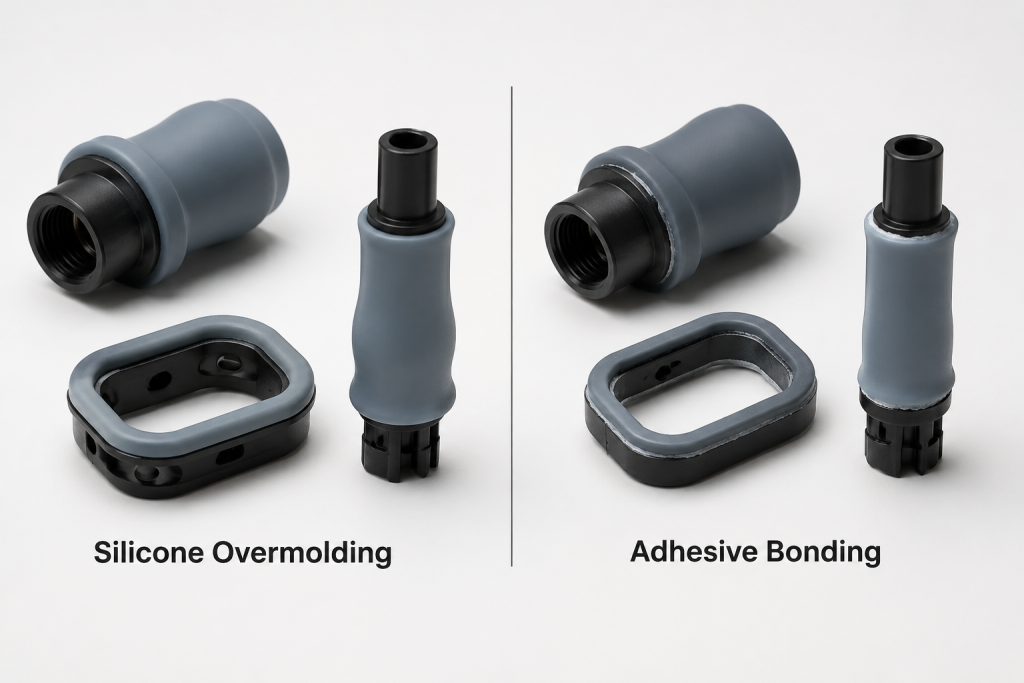
1. What Is Silicone Overmolding?
Silicone overmolding is an advanced manufacturing process where silicone is directly molded onto another component to create a single integrated part.
The substrate can include:
- Plastic components
- Metal parts
- Electronic assemblies
- Glass components
- Medical device structures
During the process, Liquid Silicone Rubber (LSR) is injected around the substrate inside a precision mold. After curing, the silicone forms a strong mechanical and chemical bond with the underlying material.
The basic process:
Substrate preparation → Mold positioning → LSR injection → Silicone curing → Finished integrated component
Silicone overmolding is widely used in industries requiring high reliability, precision, and protection.
Common applications:
- Medicinska produkter
- Electronic components
- Automotive sensors
- Wearable products
- Tätningskomponenter för industriellt bruk
2. What Is Adhesive Bonding?
Adhesive bonding is a joining method that uses an additional adhesive material to attach silicone to another substrate.
The process usually includes:
- Ytrengöring
- Surface treatment
- Adhesive application
- Silicone and substrate assembly
- Adhesive curing
Common adhesive materials include:
- Silicone adhesives
- Epoxy adhesives
- Polyurethane adhesives
- Acrylic adhesives
Adhesive bonding is often used when manufacturers need a flexible production method without investing in complex molds.
Användningsområdena omfattar:
- Prototype products
- Low-volume production
- Repair applications
- Simple silicone assemblies
3. Key Differences Between Silicone Overmolding and Adhesive Bonding
| Funktion | Överformning med silikon | Adhesive Bonding |
|---|---|---|
| Manufacturing method | Formsprutning | Adhesive joining |
| Vidhållningsstyrka | Hög | Medium |
| Production automation | Excellent | Limited |
| Ytans utseende | Seamless | Visible bonding line possible |
| Produktionsvolym | Medium to high volume | Low to medium volume |
| Initial tooling cost | Higher | Lower |
| Hållbarhet | Excellent | Depends on adhesive |
| Precision | Hög | Medium |
4. Bonding Performance Comparison
Överformning med silikon
Silicone overmolding creates a more integrated connection between silicone and substrate.
Fördelar:
- Strong mechanical attachment
- Förbättrad tätningsförmåga
- Reduced risk of separation
- Better long-term reliability
The silicone layer becomes part of the product structure rather than simply being attached to the surface.
Detta är särskilt viktigt för:
- Waterproof products
- Medicinska produkter
- High-temperature applications
Adhesive Bonding
Adhesive bonding relies on chemical adhesion between surfaces.
Bond performance depends on:
- Adhesive type
- Surface preparation
- Environmental conditions
- Aging resistance
Potential issues include:
- Adhesive degradation
- Bond failure
- Reduced performance after temperature cycling
For applications exposed to harsh conditions, adhesive bonding may require additional validation.
5. Durability and Environmental Resistance
Silicone Overmolding Advantages
Silicone overmolding provides excellent resistance against:
- Temperature changes
- Fukt
- Chemicals
- Mekanisk belastning
- Aging
Because the silicone is integrated during molding, there are fewer weak points.
Typiska användningsområden:
- Automotive sealing components
- Medical connectors
- Waterproof electronics
Adhesive Bonding Limitations
Adhesive performance can be affected by:
- Heat exposure
- Humidity
- Chemical contact
- Long-term aging
Till exempel:
A silicone product used in a high-temperature environment may experience adhesive softening or reduced bonding strength over time.
6. Manufacturing Process Comparison
Silicone Overmolding Process
Step 1: Product Design
Engineers consider:
- Substrate structure
- Silicone thickness
- Formkonstruktion
- Bonding areas
Step 2: Mold Development
Precision molds are manufactured according to product requirements.
Important factors:
- Gate design
- Avluftning
- Part positioning
Step 3: Injection Molding
Liquid Silicone Rubber is injected into the mold and cured.
Typical curing temperature:
150°C–200°C
Step 4: Quality Inspection
Products are tested for:
- Mått
- Vidhållningsstyrka
- Utseende
- Functionality
Adhesive Bonding Process
Step 1: Surface Preparation
Surfaces may require:
- Rengöring
- Plasmabehandling
- Grundfärg
Step 2: Adhesive Application
The adhesive is applied manually or automatically.
Step 3: Assembly and Curing
Components are aligned and allowed to cure.
Step 4: Inspection
Testing may include:
- Vidhållningsstyrka
- Läckagetestning
- Visuell besiktning
7. Design Flexibility Comparison
Överformning med silikon
Provides greater design freedom.
Engineers can integrate:
- Soft-touch surfaces
- Sealing structures
- Protective layers
- Ergonomic grips
Exempel:
- Medical handles
- Smart device covers
- Silicone buttons
Adhesive Bonding
Provides flexibility during product development.
Fördelar:
- Easy design changes
- Suitable for prototypes
- Lower initial investment
However, it may be more difficult to achieve complex integrated structures.
8. Cost Comparison
Silicone Overmolding Cost
Initial investment:
Higher
Main costs:
- Mögelbildning
- LSR equipment
- Engineering setup
However, for large production volumes:
- Unit cost decreases
- Labor cost is reduced
- Production consistency improves
Best suited for:
- Massproduktion
- High-quality products
- Long-term projects
Adhesive Bonding Cost
Initial investment:
Lower
Fördelar:
- No complex mold required
- Faster setup
- Suitable for small batches
However:
- More manual labor
- Higher variation between products
- Higher assembly costs
Best suited for:
- Prototypes
- Low-volume production
- Temporary solutions
9. Applications Comparison
Medicinsk industri
Silicone overmolding is widely used for:
- Medical cable assemblies
- Patient monitoring devices
- Medical connectors
- Respiratory components
Reasons:
- High reliability
- Steriliseringsbeständighet
- Better sealing
Adhesive bonding may be used for:
- Prototype medical devices
- Non-critical assemblies
Elektronikbranschen
Silicone overmolding applications:
- Vattentäta anslutningar
- Sensor protection
- Bärbara enheter
Fördelar:
- Moisture protection
- Mechanical protection
- Flexible design
Adhesive bonding applications:
- Simple electronic covers
- Small-batch products
Bilindustrin
Silicone overmolding is preferred for:
- Sensor sealing
- Cable protection
- Automotive connectors
Because automotive components require:
- Lång livslängd
- Temperaturbeständighet
- Environmental stability
10. When Should You Choose Silicone Overmolding?
Silicone overmolding is recommended when:
✔ High reliability is required
✔ Products face harsh environments
✔ Waterproof sealing is important
✔ Production volume is high
✔ A seamless appearance is needed
✔ Medical or automotive applications are involved
Exempel:
- Medicinska produkter
- Wearable electronics
- Automotive components
- Industrial seals
11. When Should You Choose Adhesive Bonding?
Adhesive bonding may be better when:
✔ Production volume is low
✔ Prototype validation is needed
✔ Tooling investment must be minimized
✔ Product structure is simple
Exempel:
- Early-stage prototypes
- Customized small batches
- Non-critical assemblies
12. Future Development Trends
As products become smaller and more complex, silicone integration technologies continue to evolve.
Future trends include:
Multi-Material Manufacturing
Combining:
- Silikon
- Plastics
- Metals
- Electronics
into single integrated components.
Medical and Wearable Devices
Growing demand for:
- Flexible materials
- Skin-friendly designs
- Vattentätt skydd
Automated Production
Increasing use of:
- LSR-formsprutning
- Robotic assembly
- Digital quality inspection
will further improve manufacturing efficiency.
Slutsats
Silicone overmolding and adhesive bonding are both useful methods for combining silicone with other materials, but they serve different manufacturing needs.
Silicone overmolding provides:
- Higher reliability
- Bättre tätningsförmåga
- Improved durability
- Efficient mass production
Adhesive bonding provides:
- Lower initial cost
- Faster development
- Flexibility for prototypes
For high-performance products, especially medical devices, electronics, automotive components, and industrial applications, silicone overmolding is often the preferred solution.
Choosing the right manufacturing method depends on product requirements, production volume, performance expectations, and long-term application conditions.
Working with an experienced silicone manufacturer can help companies select the most suitable process and achieve better product quality, reliability, and cost efficiency.
 English
  Japanese
  Korean
  German
  French
  Italian
  Spanish
  Dutch
Dutch  Chinese
  Portuguese
  Polish
  Czech
Czech  Hungarian
  Swedish
  Finnish
  Vietnamese
  Thai
Thai  Turkish
  Arabic
  Russian